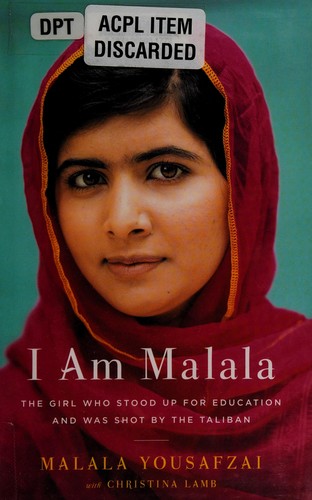
Talk to I Am Malala like its author wrote you back.
Get the ideas that fit your life — not generic summaries.
- Chat with the book
- Audiobook-style main ideas
- Adapts to your life and goals
- Helps you take action
I Am Malala, in detail
I Am Malala is the memoir of Malala Yousafzai, the Pakistani activist who was shot by the Taliban on her school bus in October 2012 at age fifteen, and who survived to become the youngest recipient of the Nobel Peace Prize. Written with journalist Christina Lamb, the book moves between Malala's childhood in the Swat Valley, the Taliban's progressive takeover of the region, and the years leading up to the assassination attempt. It is a book about one girl's education, one family's values, and one society's disintegration under ideological violence.
The heart of the book is the relationship between Malala and her father, Ziauddin, a school founder and education activist who raised his daughter to speak publicly at a time and in a place where girls were expected to disappear from public life. The Yousafzai family's Pashtun culture, their attachment to the Swat Valley's landscape, and their particular version of Islam — one that Malala argues is incompatible with what the Taliban practiced — are rendered with specificity and genuine warmth. This is not a book that traffics in abstractions about "Muslim societies." It is about one family's specific life.
The Taliban's rise in Swat is documented in escalating detail: the burning of schools, the banning of music, the executions, the grip of fear that made neighbors stop greeting each other. Malala wrote an anonymous blog for the BBC during this period, and the book incorporates those dispatches alongside retrospective reflection. The tension between her public courage and her private fear is one of the most honest threads in the memoir.
The book is co-authored, and readers should take that into account when evaluating its voice — there are passages that feel smoothed for a Western audience. But the core experience it documents is Malala's own, and the clarity of her conviction about education as a fundamental right gives the book a coherence that transcends its structural unevenness. It is most powerful as a firsthand account of what it means to grow up under ideological occupation, and what it costs to refuse to be silent.
The big ideas
- 1.
Education is not a neutral good in contexts of ideological control. The Taliban targeted schools precisely because literacy and learning are tools of resistance.
- 2.
Malala's activism was shaped by her father's belief that his daughter should have a public voice, at a time when Pashtun custom and Taliban pressure both argued for silence.
- 3.
The Taliban's takeover of Swat was incremental — radio broadcasts, then threats, then executions — and ordinary life continued alongside the violence longer than outside observers tend to imagine.
