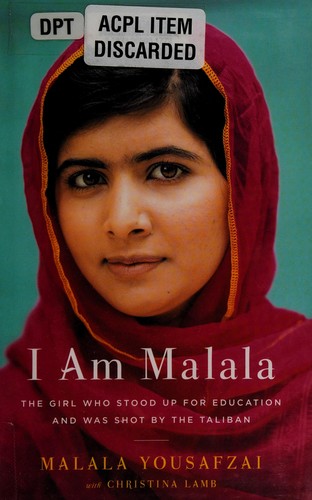
I Am Malala by Malala Yousafzai is a 2013 memoir book about education, courage, women's rights. Education is not a neutral good in contexts of ideological control. The Taliban targeted schools precisely because literacy and learning are tools of resistance.
Summary
I Am Malala is the memoir of Malala Yousafzai, the Pakistani activist who was shot by the Taliban on her school bus in October 2012 at age fifteen, and who survived to become the youngest recipient of the Nobel Peace Prize. Written with journalist Christina Lamb, the book moves between Malala's childhood in the Swat Valley, the Taliban's progressive takeover of the region, and the years leading up to the assassination attempt. It is a book about one girl's education, one family's values, and one society's disintegration under ideological violence.
The heart of the book is the relationship between Malala and her father, Ziauddin, a school founder and education activist who raised his daughter to speak publicly at a time and in a place where girls were expected to disappear from public life. The Yousafzai family's Pashtun culture, their attachment to the Swat Valley's landscape, and their particular version of Islam — one that Malala argues is incompatible with what the Taliban practiced — are rendered with specificity and genuine warmth. This is not a book that traffics in abstractions about "Muslim societies." It is about one family's specific life.
The Taliban's rise in Swat is documented in escalating detail: the burning of schools, the banning of music, the executions, the grip of fear that made neighbors stop greeting each other. Malala wrote an anonymous blog for the BBC during this period, and the book incorporates those dispatches alongside retrospective reflection. The tension between her public courage and her private fear is one of the most honest threads in the memoir.
The book is co-authored, and readers should take that into account when evaluating its voice — there are passages that feel smoothed for a Western audience. But the core experience it documents is Malala's own, and the clarity of her conviction about education as a fundamental right gives the book a coherence that transcends its structural unevenness. It is most powerful as a firsthand account of what it means to grow up under ideological occupation, and what it costs to refuse to be silent.
Talk to I Am Malala like its author wrote you back.
Get the ideas that fit your life — not generic summaries.
- Chat with the book
- Audiobook-style main ideas
- Adapts to your life and goals
- Helps you take action
Key takeaways
- 1.
Education is not a neutral good in contexts of ideological control. The Taliban targeted schools precisely because literacy and learning are tools of resistance.
- 2.
Malala's activism was shaped by her father's belief that his daughter should have a public voice, at a time when Pashtun custom and Taliban pressure both argued for silence.
- 3.
The Taliban's takeover of Swat was incremental — radio broadcasts, then threats, then executions — and ordinary life continued alongside the violence longer than outside observers tend to imagine.
- 4.
Malala's anonymity as the BBC blogger was an open secret. Her decision to continue speaking publicly was not ignorance of the risk but a deliberate choice to refuse intimidation.
- 5.
The shooting transformed Malala from a local activist into a global symbol — a transformation she reflects on with both gratitude and a clear-eyed awareness of what was lost.
- 6.
Pakistan's internal divisions over the Taliban — military, civilian, religious — are a recurring theme. Malala does not flatten these into a simple story of heroes and villains.
- 7.
The recovery was not a clean miracle. Malala's account of waking in a Birmingham hospital, not knowing whether her father was alive, is one of the most affecting passages in the memoir.
- 8.
The Nobel Peace Prize came when Malala was seventeen. She frames it not as a personal achievement but as recognition of the cause — which is either admirable humility or the cost of being a symbol rather than a person.
Discussion questions
Use these on your own, with a book club, or as chat starters in Superbook. Book club version, ready to copy or print →
- 1.
Malala frames education as a right she was willing to die for. Do you think that framing is universal, culturally specific, or something in between?
- 2.
Her father, Ziauddin, is in many ways the central adult figure in the book. How did his choices — including the decision to keep speaking publicly — shape both Malala's activism and the family's risk?
- 3.
The Taliban's control of Swat was built on fear and incremental compliance. At what point do you think resistance becomes possible in such an environment, and what makes it so difficult before then?
- 4.
Malala acknowledges that her anonymity as the BBC blogger was an open secret. What does that tell us about how public figures navigate between visibility and protection?
- 5.
The book is co-authored by a journalist. How does that affect how you read it as a memoir? Does it matter whether every sentence came directly from Malala?
- 6.
Malala says her Islam is incompatible with the Taliban's. How does the book handle the distinction between the religion and its ideological weaponization, and does it do so convincingly?
- 7.
After the shooting, Malala became a global symbol. What does it cost a person to become a symbol, and does the book reckon honestly with that cost?
- 8.
The Yousafzai family's attachment to the Swat Valley is a recurring theme. What does it mean to love a place that has been made dangerous by the people who also claim to love it?
- 9.
Pakistan's internal politics around the Taliban — complicity, denial, selective enforcement — are documented in the book. How do these complicate the simple narrative of brave girl versus violent extremism?
- 10.
Malala received the Nobel Peace Prize at seventeen. Is there something troubling about the way the world elevates individual survivors as symbols, rather than addressing the structural conditions that create them?
- 11.
Have you changed any behavior or assumption as a result of reading this book? If yes, what? If not, why not?
- 12.
Malala's story is widely used in schools. What are the risks of turning a living person's memoir into a pedagogical symbol?
Themes
Frequently asked questions
-
Is I Am Malala worth reading?
Yes, particularly for readers who want a firsthand account of life under Taliban occupation in Pakistan rather than an outside analysis. The book is uneven in places due to co-authorship, but the core experience is vivid and the family portrait is genuinely moving.
-
How long is I Am Malala?
Around 300 pages, or roughly six hours of reading time at average pace. It reads quickly once past the early historical context sections.
-
What is I Am Malala about?
Malala Yousafzai's childhood in Pakistan's Swat Valley, the Taliban's takeover of the region and its suppression of girls' education, her own activism, and the assassination attempt that nearly killed her at fifteen and ultimately made her a global symbol of the right to education.
-
Who should read I Am Malala?
Anyone interested in Pakistan, women's rights, the Taliban's ideology, or the political economy of education access. It is also a strong choice for book clubs that want to discuss courage, identity, and the cost of public activism.
-
Is the book anti-Islam?
No. Malala is a practicing Muslim who is explicit that her faith is central to her identity. Her argument is that the Taliban's ideology is a perversion of Islam, not a representation of it. The book is critical of the Taliban specifically, and it also criticizes the Pakistani military and government for tolerating and at times supporting extremism.