Talk to In the Blink of an Eye like its author wrote you back.
Get the ideas that fit your life — not generic summaries.
- Chat with the book
- Audiobook-style main ideas
- Adapts to your life and goals
- Helps you take action
What it argues
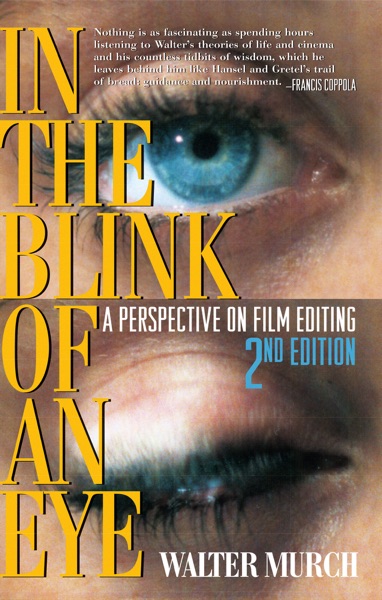
In the Blink of an Eye is Walter Murch's extended meditation on film editing — what it is, why it works, and what an editor is actually doing when they cut from one image to another. Murch, whose credits include Apocalypse Now, The Godfather Part II, The Conversation, and The English Patient, writes from decades of practice, and the book has the authority of someone who has spent a career thinking carefully about a craft that is rarely examined theoretically.
The title comes from the observation that we blink, on average, at the emotional and cognitive moments where a cut would naturally occur — at the end of a thought, at a shift in attention, at a resolution of tension. Murch uses this to argue that film editing is not an artificial convention imposed on audiences but something that corresponds to how the mind naturally processes experience. A well-placed cut feels natural because it mimics the blink of attention.
What it gets right
- 1.
Film editing works because cuts correspond to natural breaks in human attention — the blink that occurs at emotional and cognitive transitions.
- 2.
Murch's six criteria for a cut, in descending priority: emotion, story, rhythm, eye-trace, planarity, three-dimensional continuity. Most editors of his era were working the hierarchy in reverse.
- 3.
Emotion is the most important criterion for a cut. If a cut feels wrong emotionally, technical continuity cannot save it.
What it covers
Who wrote it
Walter Murch is an American film editor and sound designer who has worked on some of the most celebrated American films of the past fifty years, including The Conversation, Apocalypse Now, The Godfather Part II, and The English Patient, for which he won Academy Awards for both editing and sound mixing. He was among the first major editors to complete a feature film on a digital editing system. A first edition of In the Blink of an Eye was published in 1995 and an expanded second edition appeared in 2001. Murch has also worked as a writer and translator and was a student of George Lucas's at USC.
