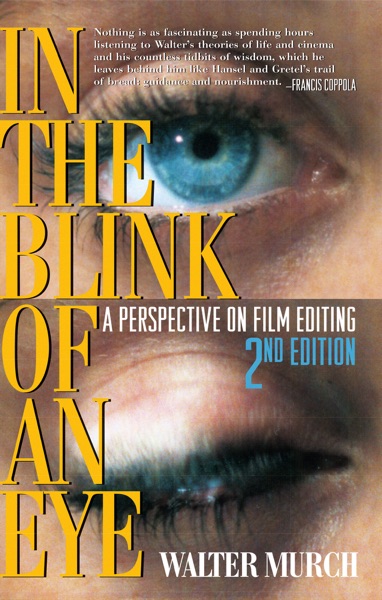
In the Blink of an Eye by Walter Murch is a 1995 philosophy book about film editing, craft and intuition, visual storytelling. Film editing works because cuts correspond to natural breaks in human attention — the blink that occurs at emotional and cognitive transitions.
Summary
In the Blink of an Eye is Walter Murch's extended meditation on film editing — what it is, why it works, and what an editor is actually doing when they cut from one image to another. Murch, whose credits include Apocalypse Now, The Godfather Part II, The Conversation, and The English Patient, writes from decades of practice, and the book has the authority of someone who has spent a career thinking carefully about a craft that is rarely examined theoretically.
The title comes from the observation that we blink, on average, at the emotional and cognitive moments where a cut would naturally occur — at the end of a thought, at a shift in attention, at a resolution of tension. Murch uses this to argue that film editing is not an artificial convention imposed on audiences but something that corresponds to how the mind naturally processes experience. A well-placed cut feels natural because it mimics the blink of attention.
The most cited part of the book is Murch's hierarchy of editing criteria. He identifies six qualities he weighs when deciding where to cut: emotion (how the cut makes the audience feel), story (does it advance what needs advancing), rhythm (is this the right moment in the musical flow), eye-trace (where the eye is looking), planarity (the two-dimensional balance of the frame), and three-dimensional continuity (spatial coherence). Emotion comes first; spatial continuity comes last. The film industry convention at the time Murch was writing weighted these in roughly the reverse order, and the hierarchy is a clear, deliberate argument about where craft priorities should lie.
The book also addresses the transition from film to digital editing. Murch was among the first major editors to cut a feature on a computer — The English Patient on Avid — and he reflects on what changes and what is lost when the physical handling of film is replaced by a cursor. The analog process imposed a discipline of choice; digital encourages indecision and over-cutting. This section, written in 1995, has proved prescient.
The book is short and concentrated — more essay than manual. It will not teach you to edit, but it will give you a way of thinking about editing, and about what makes any time-based art feel right.
Talk to In the Blink of an Eye like its author wrote you back.
Get the ideas that fit your life — not generic summaries.
- Chat with the book
- Audiobook-style main ideas
- Adapts to your life and goals
- Helps you take action
Key takeaways
- 1.
Film editing works because cuts correspond to natural breaks in human attention — the blink that occurs at emotional and cognitive transitions.
- 2.
Murch's six criteria for a cut, in descending priority: emotion, story, rhythm, eye-trace, planarity, three-dimensional continuity. Most editors of his era were working the hierarchy in reverse.
- 3.
Emotion is the most important criterion for a cut. If a cut feels wrong emotionally, technical continuity cannot save it.
- 4.
Editing is not merely assembly of footage but the creation of a continuous present-tense experience for the viewer — a waking dream that the editor shapes.
- 5.
The transition from film to digital editing changed how editors work. Film imposed a discipline of choice through physical cost; digital enables endless iteration, which is not always better.
- 6.
An editor's job is partly to protect the audience's capacity for imagination by leaving some things unshown — overexplaining destroys the collaborative space between film and viewer.
- 7.
The best cuts are invisible not because they are technically smooth but because they feel emotionally right. The audience forgives technical discontinuity and does not forgive emotional false notes.
Discussion questions
Use these on your own, with a book club, or as chat starters in Superbook. Book club version, ready to copy or print →
- 1.
Murch argues emotion is the primary criterion for a cut. Think of a scene from a film where a cut felt wrong to you — was it an emotional problem or a technical one?
- 2.
The blink metaphor suggests editing aligns with natural cognitive rhythms. Does learning that change how you experience cuts in a film you love?
- 3.
Murch says digital editing enables endless iteration — but that this is not always an improvement. Does unlimited choice reliably produce better work in fields you know well?
- 4.
The hierarchy of editing criteria places spatial continuity last. What happens in films where it is placed first?
- 5.
Murch describes editing as creating a continuous present for the viewer. What other arts create that same quality of sustained present-tense experience?
- 6.
He argues that leaving things unshown preserves space for the viewer's imagination. Where in films you admire do you notice this restraint, and where do you notice its absence?
- 7.
How much of film editing — or any craft — do you think is learnable from principles, and how much requires years of accumulated sensory intuition?
- 8.
Murch's criteria apply cleanly to fiction film. Do you think they map to documentary, essay film, or experimental work?
- 9.
The book was written in 1995 and revised in 2001. What aspects of the argument feel more or less true given how much editing practice and consumption has changed since?
- 10.
Murch suggests that overexplaining destroys something in a film. What's the equivalent in writing, music, or design?
- 11.
He spent his career in collaboration — with Coppola, Nichols, Minghella. How much of what he describes as craft is actually something emergent from long creative partnerships?
Themes
Frequently asked questions
-
What is In the Blink of an Eye about?
It's Walter Murch's account of what film editing is and why it works — focused on the principles underlying the craft rather than technical instruction. The book argues that cuts work when they align with natural breaks in human attention, and that emotion should be the editor's primary criterion.
-
Is In the Blink of an Eye worth reading?
Yes, especially for anyone working in any time-based medium — film, video, podcasting, music. The thinking about where to cut applies more broadly than film, and the hierarchy of editing criteria is a genuinely useful framework for any kind of sequence-based decision-making.
-
How long is In the Blink of an Eye?
About 150 pages — a two to three hour read. It's concentrated and worth reading slowly rather than skimming.
-
Do I need to know about filmmaking to read this book?
No. Murch writes for general readers as much as practitioners. A passing familiarity with classic films helps, but the core arguments about attention, perception, and craft are accessible without a technical background.
-
What is Murch's most important insight about editing?
That emotion comes first. A cut can violate spatial continuity, temporal continuity, and rhythmic convention and still work if it is emotionally true. A cut that is technically perfect but emotionally false will always feel wrong, and no amount of technical correction will fix it.
Similar books
The Creative Habit
Twyla Tharp
Steal Like an Artist
Austin Kleon
On Writing: A Memoir of the Craft
Stephen King
Creativity, Inc.: Overcoming the Unseen Forces That Stand in the Way of True Inspiration
Ed Catmull and Amy Wallace
