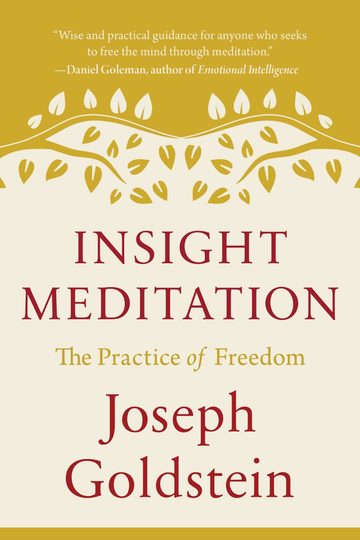
Talk to Insight Meditation: The Practice of Freedom like its author wrote you back.
Get the ideas that fit your life — not generic summaries.
- Chat with the book
- Audiobook-style main ideas
- Adapts to your life and goals
- Helps you take action
Insight Meditation: The Practice of Freedom, in detail
Insight Meditation: The Practice of Freedom is Joseph Goldstein's distillation of vipassana — the Theravada Buddhist practice of direct investigation into the nature of mind and experience. Published in 1993, it remains one of the clearest introductions to the tradition available in English, written by a teacher who has practiced and taught for decades after studying in India and Burma with masters including S.N. Goenka and Anagarika Munindra.
The book's core premise is that suffering arises from a fundamental misperception: we treat our thoughts, feelings, and sense of self as solid, continuous, and inherently ours, when direct observation reveals them to be impermanent, arising and passing without a fixed controller behind them. Insight meditation is the practice of looking directly at experience as it arises, moment by moment, rather than being swept along in it. The result, at depth, is not a pleasant meditative state but a fundamental shift in how the mind relates to experience — what the tradition calls liberation or freedom.
Goldstein structures the book around the foundational practices: bare attention to breathing, to bodily sensations, to sound, to emotions as they arise and pass. He introduces the three characteristics that insight meditation reveals — impermanence, unsatisfactoriness, and non-self — not as doctrines to be accepted but as findings that a practitioner verifies through direct observation. The chapters on lovingkindness (metta) and compassion (karuna) show how insight practice connects to ethical life and relationships rather than remaining a private affair.
The tone is careful and unrhetorical. Goldstein does not hype the benefits of meditation or make large claims about what it will do for productivity or stress levels. He is interested in freedom in a deeper sense — the reduction of compulsive reactivity, the loosening of the grip of craving and aversion — and he's clear that this requires sustained practice over a long period, not a ten-day retreat. For readers already familiar with mindfulness, the book offers a more complete picture of the tradition those practices come from. For beginners willing to take the practice seriously, it is among the best entry points.
The big ideas
- 1.
Vipassana means 'clear seeing': the practice is not relaxation or concentration alone but direct investigation of how experience actually arises and passes.
- 2.
The three characteristics — impermanence, unsatisfactoriness (dukkha), and non-self — are not doctrines to be believed but qualities of experience that sustained attention reveals directly.
- 3.
Bare attention means observing what arises in the mind without adding to it or subtracting from it — noticing the experience of anger, for example, without being angry or trying to suppress the anger.
