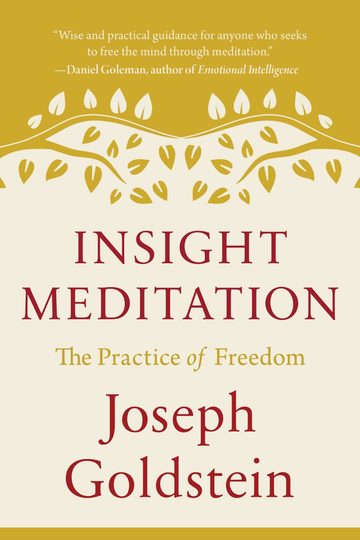
Insight Meditation: The Practice of Freedom by Joseph Goldstein is a 1993 religion & spirituality book about meditation, mindfulness, buddhist practice. Vipassana means 'clear seeing': the practice is not relaxation or concentration alone but direct investigation of how experience actually arises and passes.
Summary
Insight Meditation: The Practice of Freedom is Joseph Goldstein's distillation of vipassana — the Theravada Buddhist practice of direct investigation into the nature of mind and experience. Published in 1993, it remains one of the clearest introductions to the tradition available in English, written by a teacher who has practiced and taught for decades after studying in India and Burma with masters including S.N. Goenka and Anagarika Munindra.
The book's core premise is that suffering arises from a fundamental misperception: we treat our thoughts, feelings, and sense of self as solid, continuous, and inherently ours, when direct observation reveals them to be impermanent, arising and passing without a fixed controller behind them. Insight meditation is the practice of looking directly at experience as it arises, moment by moment, rather than being swept along in it. The result, at depth, is not a pleasant meditative state but a fundamental shift in how the mind relates to experience — what the tradition calls liberation or freedom.
Goldstein structures the book around the foundational practices: bare attention to breathing, to bodily sensations, to sound, to emotions as they arise and pass. He introduces the three characteristics that insight meditation reveals — impermanence, unsatisfactoriness, and non-self — not as doctrines to be accepted but as findings that a practitioner verifies through direct observation. The chapters on lovingkindness (metta) and compassion (karuna) show how insight practice connects to ethical life and relationships rather than remaining a private affair.
The tone is careful and unrhetorical. Goldstein does not hype the benefits of meditation or make large claims about what it will do for productivity or stress levels. He is interested in freedom in a deeper sense — the reduction of compulsive reactivity, the loosening of the grip of craving and aversion — and he's clear that this requires sustained practice over a long period, not a ten-day retreat. For readers already familiar with mindfulness, the book offers a more complete picture of the tradition those practices come from. For beginners willing to take the practice seriously, it is among the best entry points.
Talk to Insight Meditation: The Practice of Freedom like its author wrote you back.
Get the ideas that fit your life — not generic summaries.
- Chat with the book
- Audiobook-style main ideas
- Adapts to your life and goals
- Helps you take action
Key takeaways
- 1.
Vipassana means 'clear seeing': the practice is not relaxation or concentration alone but direct investigation of how experience actually arises and passes.
- 2.
The three characteristics — impermanence, unsatisfactoriness (dukkha), and non-self — are not doctrines to be believed but qualities of experience that sustained attention reveals directly.
- 3.
Bare attention means observing what arises in the mind without adding to it or subtracting from it — noticing the experience of anger, for example, without being angry or trying to suppress the anger.
- 4.
The sense of a fixed, continuous self is itself an object of investigation, not a premise. What we call 'I' is, on close inspection, a process rather than a thing.
- 5.
Lovingkindness (metta) practice — cultivating a felt wish for wellbeing toward self and others — is not separate from insight but a complement that addresses the heart's habitual movements.
- 6.
Insight meditation cannot be learned from reading alone; the book functions as a map, but the territory is your own experience during practice.
- 7.
Liberation, as Goldstein uses the term, is not a dramatic peak experience but a progressive reduction in the compulsive grip of craving and aversion — a deepening freedom in ordinary moments.
- 8.
Retreats provide concentrated conditions, but the practice is ultimately meant to change how the mind engages with ordinary daily experience, not just with formal meditation sessions.
Discussion questions
Use these on your own, with a book club, or as chat starters in Superbook. Book club version, ready to copy or print →
- 1.
Goldstein says insight meditation is not about relaxation but about clear seeing. Before reading this book, what did you think meditation was for? How has that understanding shifted?
- 2.
The practice involves observing thoughts and emotions as passing events rather than facts about the world. Have you ever experienced a moment of stepping back from a strong emotion in this way? What produced it?
- 3.
The three characteristics — impermanence, unsatisfactoriness, and non-self — are meant to be discovered in practice, not believed as doctrines. Does that distinction make them more or less compelling to you?
- 4.
Goldstein is careful not to over-promise what meditation delivers. What aspects of his description of freedom — reduced reactivity, less grip of craving and aversion — do you find genuinely appealing, and which feel remote?
- 5.
The sense of a fixed self is offered as an object of investigation rather than a premise. What would it actually mean to your daily experience if you took that seriously?
- 6.
Lovingkindness practice involves directing a felt wish for wellbeing toward people you find difficult. Is that a practice you can imagine committing to? What stops it?
- 7.
Goldstein says the book is a map, not the territory. What's the difference between understanding a practice intellectually and actually doing it? Where else in your life does that distinction show up?
- 8.
Vipassana practice asks practitioners to face experience directly rather than avoid it. What experiences do you most habitually avoid noticing, and what do you think you'd find if you turned toward them?
- 9.
The tradition Goldstein teaches comes from Theravada Buddhism. Does the religious framing affect how you receive the practice? Is it necessary to have any belief in Buddhist doctrine to do this kind of meditation?
- 10.
The book was written before the current mainstream mindfulness movement. How does what Goldstein describes compare to the mindfulness apps and programs most people encounter today?
- 11.
If you practice meditation, what is your current relationship to the three characteristics Goldstein describes? If you don't, what would it take to establish a serious practice?
Themes
Frequently asked questions
-
What is Insight Meditation: The Practice of Freedom about?
It's a guide to vipassana — the Theravada Buddhist practice of clear observation of moment-to-moment experience. Goldstein explains the core practices, the three characteristics they reveal, and the relationship between meditation and ethical life.
-
Do I need to be Buddhist to benefit from this book?
No. Goldstein presents the practice in terms that are accessible without religious commitment. The practices are investigative — you're being asked to look at your own experience, not to adopt metaphysical beliefs. That said, the framework is explicitly Buddhist, and he makes no attempt to secularize it.
-
How is this different from mainstream mindfulness books?
Mainstream mindfulness focuses primarily on stress reduction and present-moment awareness. Goldstein is interested in a deeper project: direct investigation of the nature of self and experience, with liberation from compulsive suffering as the goal. The ambition is larger and the practice is more demanding.
-
How long does it take to read?
Around three and a half to four hours. But most readers take longer because the practice instructions invite stopping to try what's being described.
-
Is this suitable for a complete beginner to meditation?
Yes, with the caveat that Goldstein consistently says you need to practice, not just read. The book gives enough instruction to begin, but finding a teacher or retreat for actual practice makes a significant difference.