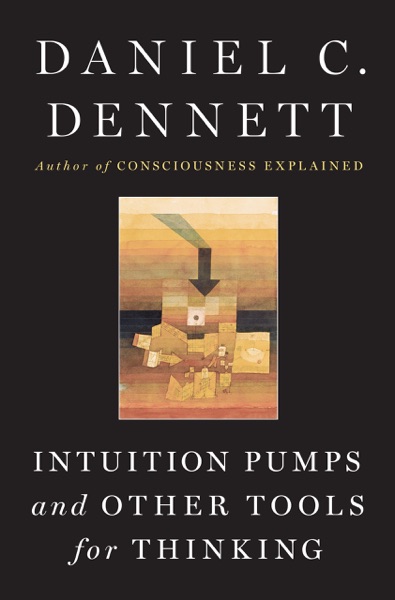
Talk to Intuition Pumps and Other Tools for Thinking like its author wrote you back.
Get the ideas that fit your life — not generic summaries.
- Chat with the book
- Audiobook-style main ideas
- Adapts to your life and goals
- Helps you take action
Intuition Pumps and Other Tools for Thinking, in detail
Intuition Pumps and Other Tools for Thinking is Daniel Dennett's handbook for thinking well — a collection of seventy-odd conceptual tools assembled across a long career in philosophy of mind, cognitive science, and evolutionary theory. The title is a phrase Dennett coined to describe thought experiments that do work by triggering intuitions rather than making rigorous arguments, and the book is partly a guide to using such tools carefully and partly a warning about using them badly.
The first section addresses general tools applicable across domains: the importance of making mistakes willingly and examining them, the value of Rapoport's Rules for charitable argument (summarize the opponent's position so well they would agree with it before you criticize it), the usefulness of Sturgeon's Law (ninety percent of everything is crud), and the rhetorical danger of applying a "deepity" — a claim that sounds profound because it can be read as trivially true or trivially false. These are practical, low-overhead tools that improve the quality of thinking almost immediately if actually applied.
The middle sections move through evolution, meaning and intentionality, free will, and consciousness. In each domain, Dennett presents the tools he has found most useful — the Library of Babel for thinking about combinatorial possibilities, intuition pumps about zombies for testing claims about consciousness, the "strange inversion of reasoning" for understanding natural selection. He revisits arguments from his earlier books and sharpens them, making this a useful entry point for readers who haven't read Consciousness Explained or Darwin's Dangerous Idea.
The book is long and encyclopedic rather than tightly argued. Dennett is at his best when he is concrete and at his most irritating when he is dismissive of objections he doesn't engage with fully. But as a survey of one of the most productive philosophical minds of the late twentieth century, Intuition Pumps is unusually honest about how it works — this is a philosopher showing his tools, not just his conclusions.
The big ideas
- 1.
An intuition pump is a thought experiment designed to trigger an intuition rather than make a rigorous argument. They are useful but can also mislead if the intuition they trigger is unreliable.
- 2.
Rapoport's Rules: before criticizing any position, restate it accurately enough that the person holding it would agree with your summary. This rule alone would improve most arguments significantly.
- 3.
Sturgeon's Law reminds you not to evaluate a genre, discipline, or tradition by its worst examples — ninety percent of everything is crud, and that doesn't distinguish between fields.
