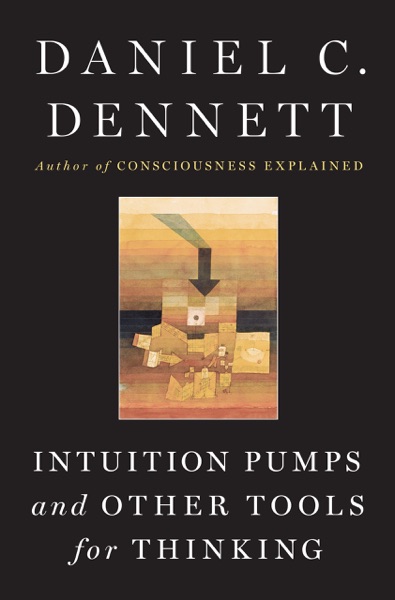
Intuition Pumps and Other Tools for Thinking by Daniel Dennett is a 2013 philosophy book about critical thinking, philosophy of mind, argumentation. An intuition pump is a thought experiment designed to trigger an intuition rather than make a rigorous argument. They are useful but can also mislead if the intuition they trigger is unreliable.
Summary
Intuition Pumps and Other Tools for Thinking is Daniel Dennett's handbook for thinking well — a collection of seventy-odd conceptual tools assembled across a long career in philosophy of mind, cognitive science, and evolutionary theory. The title is a phrase Dennett coined to describe thought experiments that do work by triggering intuitions rather than making rigorous arguments, and the book is partly a guide to using such tools carefully and partly a warning about using them badly.
The first section addresses general tools applicable across domains: the importance of making mistakes willingly and examining them, the value of Rapoport's Rules for charitable argument (summarize the opponent's position so well they would agree with it before you criticize it), the usefulness of Sturgeon's Law (ninety percent of everything is crud), and the rhetorical danger of applying a "deepity" — a claim that sounds profound because it can be read as trivially true or trivially false. These are practical, low-overhead tools that improve the quality of thinking almost immediately if actually applied.
The middle sections move through evolution, meaning and intentionality, free will, and consciousness. In each domain, Dennett presents the tools he has found most useful — the Library of Babel for thinking about combinatorial possibilities, intuition pumps about zombies for testing claims about consciousness, the "strange inversion of reasoning" for understanding natural selection. He revisits arguments from his earlier books and sharpens them, making this a useful entry point for readers who haven't read Consciousness Explained or Darwin's Dangerous Idea.
The book is long and encyclopedic rather than tightly argued. Dennett is at his best when he is concrete and at his most irritating when he is dismissive of objections he doesn't engage with fully. But as a survey of one of the most productive philosophical minds of the late twentieth century, Intuition Pumps is unusually honest about how it works — this is a philosopher showing his tools, not just his conclusions.
Talk to Intuition Pumps and Other Tools for Thinking like its author wrote you back.
Get the ideas that fit your life — not generic summaries.
- Chat with the book
- Audiobook-style main ideas
- Adapts to your life and goals
- Helps you take action
Key takeaways
- 1.
An intuition pump is a thought experiment designed to trigger an intuition rather than make a rigorous argument. They are useful but can also mislead if the intuition they trigger is unreliable.
- 2.
Rapoport's Rules: before criticizing any position, restate it accurately enough that the person holding it would agree with your summary. This rule alone would improve most arguments significantly.
- 3.
Sturgeon's Law reminds you not to evaluate a genre, discipline, or tradition by its worst examples — ninety percent of everything is crud, and that doesn't distinguish between fields.
- 4.
A 'deepity' is a claim that seems profound because it can be read two ways: in one reading it is obviously true but trivially so; in another it is false but interesting. Recognizing them saves enormous intellectual time.
- 5.
The intentional stance is a tool for predicting behavior: treat any system — person, animal, or machine — as if it had beliefs, desires, and rational agency, and see how far that gets you. The stance is pragmatically useful even if philosophically contested.
- 6.
Natural selection is a 'strange inversion of reasoning': it generates complexity from simplicity and design-looking outcomes without a designer. The inversion is what makes it so counterintuitive and why so many people resist it.
- 7.
Free will, in Dennett's view, is compatible with determinism — the question is not whether the universe is deterministic but whether the freedom that matters to us morally and practically is preserved under determinism.
- 8.
Philosophy at its best works like good engineering: it identifies which problems are genuine and which are pseudo-problems generated by confused language, and dissolves the latter rather than trying to solve them.
Discussion questions
Use these on your own, with a book club, or as chat starters in Superbook. Book club version, ready to copy or print →
- 1.
Dennett distinguishes between intuition pumps that illuminate and ones that mislead. Can you think of a popular thought experiment you find persuasive that might actually be misleading you?
- 2.
Rapoport's Rules ask you to summarize an opponent's view so well they would endorse it. When did you last actually do that — and how often do you see it done in public discourse?
- 3.
The 'deepity' concept is a useful diagnostic. Can you identify a claim in your own professional or personal life that sounds profound but, on examination, turns out to be empty?
- 4.
Dennett defends a compatibilist view of free will — the idea that free will is real and compatible with determinism. Does that position satisfy your intuitions about moral responsibility? Why or why not?
- 5.
The intentional stance treats systems as rational agents for predictive purposes. How do you decide when to apply the intentional stance to an institution, an algorithm, or a market?
- 6.
Dennett argues that consciousness can be explained naturalistically without remainder. Do you think there is something left over that his framework doesn't account for?
- 7.
The book is long and ranges across many domains. Which of Dennett's tools have you found most immediately useful, and which felt most like a solution looking for a problem?
- 8.
Dennett is critical of what he calls 'belief in belief' — the view that religious beliefs should be protected from examination because of their social value. Do you find that criticism fair?
- 9.
Several of Dennett's thought experiments (Quining Qualia, the Philosophical Zombie) are addressed specifically at philosophers. How useful do you find them as a non-specialist?
- 10.
Dennett argues that most philosophical problems about consciousness are generated by confused language rather than genuine mysteries. What would be lost if that view is right?
- 11.
The book was written in part as a counterargument to thinkers like Thomas Nagel and John Searle. Without knowing their work, how does the polemical context affect how you read Dennett?
- 12.
Dennett's tone is confident to the point of sometimes being dismissive. Does the style make the ideas more or less compelling to you?
Themes
Frequently asked questions
-
Is Intuition Pumps suitable for readers without a philosophy background?
Yes, though the later sections on consciousness and free will assume some familiarity with the debates Dennett is entering. The general tools in the first section are accessible to anyone. Readers with no prior exposure to philosophy of mind may want to read a short overview of the key debates first.
-
What is the best way to read Intuition Pumps?
Not necessarily cover to cover. The book is organized as a collection of tools, and many sections stand alone. Reading the first section on general tools carefully, then dipping into the topics you find most relevant, is more useful than trying to absorb all seventy entries in sequence.
-
Is this book better than Dennett's earlier works?
It is more accessible than Consciousness Explained and better organized than Darwin's Dangerous Idea, at the cost of being less thorough on any single argument. For readers new to Dennett, it is probably the right starting point. For readers who have already read his major books, it will feel more like a companion than a significant advance.
-
What is Dennett's view on consciousness in a sentence?
Consciousness is a product of neural processes and can be explained without invoking anything beyond ordinary physical mechanisms — there is no special 'what it is like' that stands outside natural science, and the intuitions that seem to suggest otherwise are reliable guides to subjective experience but not to metaphysics.
-
Who should read this book?
Curious generalists who want to think more precisely, philosophers and cognitive scientists who want a single-volume tour of Dennett's toolkit, and anyone who has ever encountered a thought experiment that felt compelling but couldn't explain why it bothered them.