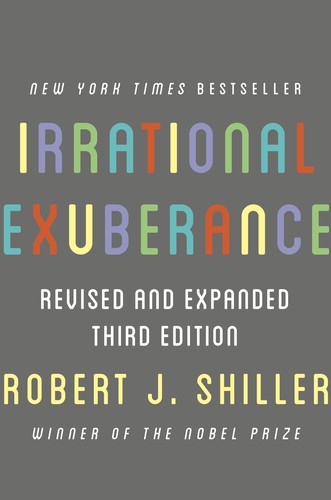
Talk to Irrational Exuberance like its author wrote you back.
Get the ideas that fit your life — not generic summaries.
- Chat with the book
- Audiobook-style main ideas
- Adapts to your life and goals
- Helps you take action
What it argues
Irrational Exuberance is Robert Shiller's argument that stock and real estate markets are driven not just by rational calculation but by feedback loops, stories, and crowd psychology. The title borrows Alan Greenspan's 1996 phrase; Shiller published the first edition just before the dot-com crash and updated it twice — after the housing collapse of 2008 and again in 2015. The book is a sustained case that asset prices can stay disconnected from fundamental value for years, and that this disconnect is predictable if not precisely timeable.
The core analytical tool is the CAPE ratio — cyclically adjusted price-to-earnings — which smooths earnings over ten years to remove cyclical noise. When CAPE reaches extremes, historical returns over the following decade have been poor. Shiller documents that in 2000, and again in 2006 in housing, the ratio was at historic highs. He is careful not to claim this is a timing signal; markets can stay overvalued through several earnings cycles. But the longer-run expectation was clear.
What it gets right
- 1.
The CAPE ratio — ten-year smoothed earnings relative to price — is one of the most reliable long-run predictors of future equity returns, even if it is useless for short-run timing.
- 2.
Asset bubbles are fed by feedback loops: rising prices generate positive stories, which attract more buyers, which push prices higher, reinforcing the narrative further.
- 3.
Every major bubble has been accompanied by a 'new era' story that explained why traditional valuation measures no longer applied. They always did.
What it covers
Who wrote it
Robert J. Shiller is Sterling Professor of Economics at Yale University and a 2013 Nobel laureate in economics. He developed the Case-Shiller home price index, which remains the standard measure of U.S. residential real estate prices, and the CAPE ratio, now widely used by institutional investors to assess equity market valuations. His other books include Narrative Economics and Animal Spirits, co-written with George Akerlof. He writes a regular column for Project Syndicate and has spent his career bridging academic economics and the study of financial markets.
