Irrational Exuberance by Robert J. Shiller is a 2000 economics book about market bubbles, investor psychology, valuation. The CAPE ratio — ten-year smoothed earnings relative to price — is one of the most reliable long-run predictors of future equity returns, even if it is useless for short-run timing.
Summary
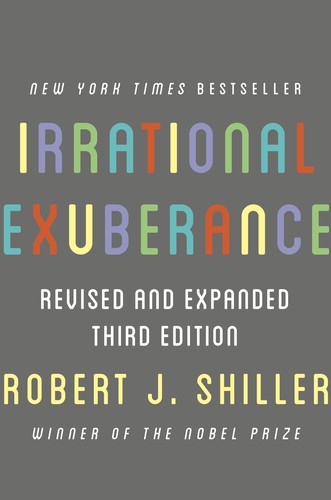
Irrational Exuberance is Robert Shiller's argument that stock and real estate markets are driven not just by rational calculation but by feedback loops, stories, and crowd psychology. The title borrows Alan Greenspan's 1996 phrase; Shiller published the first edition just before the dot-com crash and updated it twice — after the housing collapse of 2008 and again in 2015. The book is a sustained case that asset prices can stay disconnected from fundamental value for years, and that this disconnect is predictable if not precisely timeable.
The core analytical tool is the CAPE ratio — cyclically adjusted price-to-earnings — which smooths earnings over ten years to remove cyclical noise. When CAPE reaches extremes, historical returns over the following decade have been poor. Shiller documents that in 2000, and again in 2006 in housing, the ratio was at historic highs. He is careful not to claim this is a timing signal; markets can stay overvalued through several earnings cycles. But the longer-run expectation was clear.
The second strand of the argument is behavioral. Shiller catalogs the amplifying mechanisms: media feedback loops that amplify enthusiasm, the "new era" narrative that justifies any price level, overconfidence among individual investors, and anchoring effects that make people buy what has recently risen. These mechanisms are not irrational in a naive sense — they make evolutionary sense — but they are systematically biased toward pushing prices up in good times and down in bad ones, past any level that fundamentals alone would justify.
The book works best as a corrective to the strong version of the efficient market hypothesis. Shiller does not argue you can beat the market by acting on his research; he argues the market is less self-correcting than most people assume, and that this has implications for policy, retirement planning, and how much confidence anyone should place in current prices as a reliable signal of future returns.
Talk to Irrational Exuberance like its author wrote you back.
Get the ideas that fit your life — not generic summaries.
- Chat with the book
- Audiobook-style main ideas
- Adapts to your life and goals
- Helps you take action
Key takeaways
- 1.
The CAPE ratio — ten-year smoothed earnings relative to price — is one of the most reliable long-run predictors of future equity returns, even if it is useless for short-run timing.
- 2.
Asset bubbles are fed by feedback loops: rising prices generate positive stories, which attract more buyers, which push prices higher, reinforcing the narrative further.
- 3.
Every major bubble has been accompanied by a 'new era' story that explained why traditional valuation measures no longer applied. They always did.
- 4.
Individual investors are systematically overconfident in their own judgment and in the reliability of recent returns as a guide to future returns.
- 5.
The efficient market hypothesis describes a useful benchmark, not a description of reality. Prices can deviate from fundamental value for longer than any individual investor can remain solvent.
- 6.
Real estate markets exhibit the same psychological dynamics as equities — momentum, overconfidence, new-era narratives — but play out more slowly due to lower liquidity.
- 7.
The cultural and media environment amplifies speculative enthusiasm in ways that are hard to see when you are inside the mania and obvious in retrospect.
- 8.
Policy implications are significant: if markets are not reliably efficient, basing retirement security on stock market returns alone is a fragile social arrangement.
Discussion questions
Use these on your own, with a book club, or as chat starters in Superbook. Book club version, ready to copy or print →
- 1.
Shiller argues that CAPE predicted poor long-run returns around 2000 and 2006. Given that most investors knew this research existed, why do you think so few acted on it?
- 2.
What 'new era' narrative is most prominent in your investing environment today, and how would Shiller evaluate it?
- 3.
How much of your own financial behavior is driven by what you've recently seen friends or neighbors do? What feedback loops are you part of?
- 4.
Shiller distinguishes between a market being overvalued and a market being about to crash. How should that distinction change how an individual investor acts?
- 5.
The CAPE ratio has been elevated by historical standards for most of the period since 2010. What does that imply about the next decade's expected returns?
- 6.
Do you think the availability of low-cost index funds has made markets more or less susceptible to the dynamics Shiller describes? Why?
- 7.
Shiller criticizes the strong form of the efficient market hypothesis. What would have to be true about investor behavior for markets to be truly efficient?
- 8.
The book was published before two major crashes it effectively predicted. Why is it difficult for individuals or institutions to act on long-horizon valuation research?
- 9.
How does Shiller's analysis change how you think about the appropriate role of equities in a retirement portfolio?
- 10.
What role does financial journalism play in the feedback loops Shiller describes? Can that role be reformed, or is it structural?
- 11.
Shiller argues that housing prices are not tethered to rents or incomes over the long run. How does that square with what you've observed in your own housing market?
- 12.
If you had read this book in 1999, what specifically would you have done differently? What stopped you?
Themes
Frequently asked questions
-
Is Irrational Exuberance worth reading today?
Yes, particularly if you hold a portfolio heavily weighted toward equities. The behavioral mechanisms Shiller describes have not changed, and the CAPE ratio framework gives a concrete, data-grounded way to calibrate long-run return expectations without requiring market-timing ability.
-
What is the main argument of Irrational Exuberance?
That stock and real estate prices are driven by psychological feedback loops and cultural narratives as much as by rational calculation, and that CAPE ratios near historic highs reliably signal poor long-run returns, even if they cannot predict when a correction will happen.
-
What is the CAPE ratio and why does it matter?
CAPE stands for cyclically adjusted price-to-earnings ratio. It divides the current price by average inflation-adjusted earnings over the prior ten years, smoothing out short-term earnings swings. High readings have historically preceded poor returns over the following decade.
-
How long does it take to read Irrational Exuberance?
Around six to seven hours at average pace. The book is academic in tone — more densely argued than popular finance titles — but Shiller writes clearly and the historical chapters are accessible without an economics background.
-
Who should read this book?
Investors who want to understand how asset prices can deviate from fundamental value for long periods, and policymakers thinking about retirement systems. Less useful for readers looking for tactical investment advice — the book is diagnosis, not prescription.