Talk to Irrational Exuberance like its author wrote you back.
Get the ideas that fit your life — not generic summaries.
- Chat with the book
- Audiobook-style main ideas
- Adapts to your life and goals
- Helps you take action
Irrational Exuberance, in detail
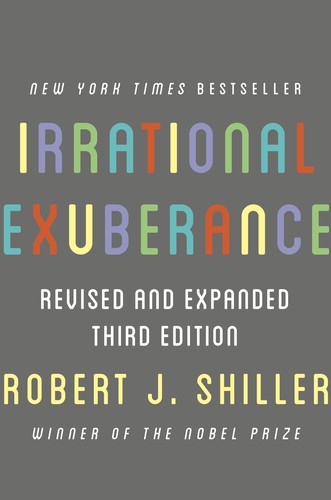
Irrational Exuberance is Robert Shiller's argument that stock and real estate markets are driven not just by rational calculation but by feedback loops, stories, and crowd psychology. The title borrows Alan Greenspan's 1996 phrase; Shiller published the first edition just before the dot-com crash and updated it twice — after the housing collapse of 2008 and again in 2015. The book is a sustained case that asset prices can stay disconnected from fundamental value for years, and that this disconnect is predictable if not precisely timeable.
The core analytical tool is the CAPE ratio — cyclically adjusted price-to-earnings — which smooths earnings over ten years to remove cyclical noise. When CAPE reaches extremes, historical returns over the following decade have been poor. Shiller documents that in 2000, and again in 2006 in housing, the ratio was at historic highs. He is careful not to claim this is a timing signal; markets can stay overvalued through several earnings cycles. But the longer-run expectation was clear.
The second strand of the argument is behavioral. Shiller catalogs the amplifying mechanisms: media feedback loops that amplify enthusiasm, the "new era" narrative that justifies any price level, overconfidence among individual investors, and anchoring effects that make people buy what has recently risen. These mechanisms are not irrational in a naive sense — they make evolutionary sense — but they are systematically biased toward pushing prices up in good times and down in bad ones, past any level that fundamentals alone would justify.
The book works best as a corrective to the strong version of the efficient market hypothesis. Shiller does not argue you can beat the market by acting on his research; he argues the market is less self-correcting than most people assume, and that this has implications for policy, retirement planning, and how much confidence anyone should place in current prices as a reliable signal of future returns.
The big ideas
- 1.
The CAPE ratio — ten-year smoothed earnings relative to price — is one of the most reliable long-run predictors of future equity returns, even if it is useless for short-run timing.
- 2.
Asset bubbles are fed by feedback loops: rising prices generate positive stories, which attract more buyers, which push prices higher, reinforcing the narrative further.
- 3.
Every major bubble has been accompanied by a 'new era' story that explained why traditional valuation measures no longer applied. They always did.
