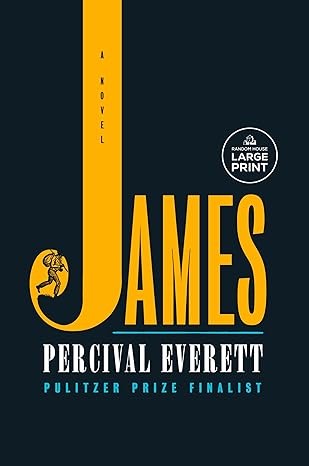
Talk to James like its author wrote you back.
Get the ideas that fit your life — not generic summaries.
- Chat with the book
- Audiobook-style main ideas
- Adapts to your life and goals
- Helps you take action
James, in detail
James retells Adventures of Huckleberry Finn from the perspective of Jim — renamed James here — the enslaved man who escapes down the Mississippi with Huck Finn. Percival Everett's version is not a corrective or an apologia for Twain's novel; it is something stranger and more ambitious. James is a fully interior novel that explores what it means to be intelligent, literate, and politically aware while performing ignorance as a survival strategy in antebellum America.
The novel's central conceit is immediately startling: James and other enslaved people secretly study language, philosophy, and literature, and have developed a deliberate dialect — the exaggerated "slave speak" they perform for white people — as a form of protective camouflage. Everett uses this to expose the labor of code-switching and the cost of sustained performance, while also making genuine philosophical points about the nature of language, freedom, and personhood. James reads Voltaire. James has views on the Enlightenment. James sees through Huck in ways Huck doesn't see through himself.
Everett writes with a controlled, precise intelligence. The novel is frequently darkly funny, occasionally horrifying, and consistently sharp. The violence of slavery is not softened — there are scenes that are genuinely difficult to read — but the novel never loses its commitment to James as a subject rather than an object. The plot follows the rough arc of the original novel while introducing James's own storyline, motivations, and interiority that Twain never supplied. The result is a novel that reads both as a self-contained work and as a conversation with the American literary canon.
This is not a comfortable book, nor is it trying to be. Readers who want fiction that challenges the canonical texts they absorbed in school and forces a reckoning with whose perspective was centered will find this essential. Those who prefer their historical retellings more celebratory or less formally ambitious may struggle with how much the novel asks of them.
The big ideas
- 1.
The 'slave dialect' that white observers read as evidence of ignorance is shown to be a deliberate performance — an act of collective survival intelligence.
- 2.
James is literate, philosophical, and politically astute; concealing those facts is not just personal survival but a form of communal protection for other enslaved people.
- 3.
The novel takes Twain's novel seriously enough to argue with it — this is not a dismissal of Huckleberry Finn but a complication of who it centered and what it saw.
