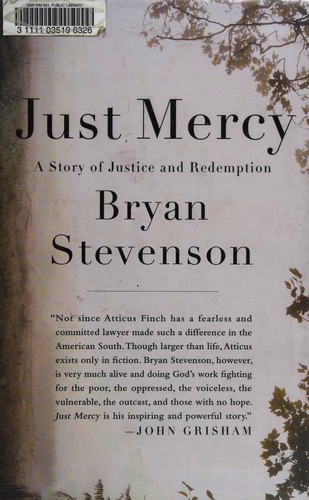
Talk to Just Mercy: A Story of Justice and Redemption like its author wrote you back.
Get the ideas that fit your life — not generic summaries.
- Chat with the book
- Audiobook-style main ideas
- Adapts to your life and goals
- Helps you take action
What it argues
Bryan Stevenson's memoir of his career as a capital defense attorney in Alabama, and specifically of his years working on the case of Walter McMillian — a Black man wrongly convicted of murder and sentenced to death in Monroe County, Alabama — is simultaneously a riveting legal narrative and a sustained moral argument about the American criminal justice system's treatment of the poor and of Black defendants. Published in 2014, it became one of the most widely assigned books in American college courses and the basis for a 2019 film.
Stevenson was a Harvard Law School graduate who, instead of joining a corporate firm, moved to Alabama in the late 1980s to work on death penalty cases for defendants who had no other legal representation. The McMillian case became his most important: Walter McMillian was an African American man with no criminal record who had been convicted of murdering a white woman in a trial that had multiple witnesses placing him elsewhere, evidence of prosecutorial misconduct, and a coerced false testimony from the actual perpetrator. He had spent years on death row before Stevenson took his case.
What it gets right
- 1.
Proximity to suffering creates moral clarity. Stevenson argues that the most important thing one can do is to get proximate to people who are suffering — that distance allows comfortable abstraction, and closeness creates obligation.
- 2.
Wrongful conviction is not an anomaly. The McMillian case is presented as an extreme instance of widespread structural failures: inadequate counsel, prosecutorial misconduct, racial bias in jury selection, coerced testimony.
- 3.
Children are not adults. One of the book's major advocacy arguments concerns the sentencing of children as adults to life without parole — a practice the Supreme Court later restricted in part because of briefs filed by the Equal Justice Initiative.
What it covers
Who wrote it
Bryan Stevenson is an American lawyer, author, and social justice activist who is the founder and executive director of the Equal Justice Initiative, a nonprofit law organization that provides legal representation to people wrongly convicted, unfairly sentenced, or abused in prison and jails. He is a professor at New York University School of Law and the recipient of numerous honorary degrees and major awards including the MacArthur "Genius" Fellowship. Just Mercy, published in 2014, was a bestseller for several years and was adapted into a 2019 film. He has argued and won multiple landmark cases before the Supreme Court, including cases restricting the sentencing of…
