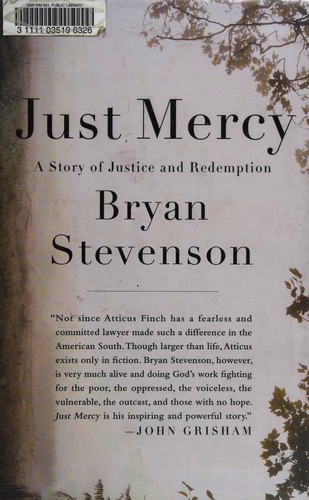
Just Mercy: A Story of Justice and Redemption by Bryan Stevenson is a 2014 memoir book about justice, race, law. Proximity to suffering creates moral clarity. Stevenson argues that the most important thing one can do is to get proximate to people who are suffering — that distance allows comfortable abstraction, and closeness creates obligation.
Summary
Bryan Stevenson's memoir of his career as a capital defense attorney in Alabama, and specifically of his years working on the case of Walter McMillian — a Black man wrongly convicted of murder and sentenced to death in Monroe County, Alabama — is simultaneously a riveting legal narrative and a sustained moral argument about the American criminal justice system's treatment of the poor and of Black defendants. Published in 2014, it became one of the most widely assigned books in American college courses and the basis for a 2019 film.
Stevenson was a Harvard Law School graduate who, instead of joining a corporate firm, moved to Alabama in the late 1980s to work on death penalty cases for defendants who had no other legal representation. The McMillian case became his most important: Walter McMillian was an African American man with no criminal record who had been convicted of murdering a white woman in a trial that had multiple witnesses placing him elsewhere, evidence of prosecutorial misconduct, and a coerced false testimony from the actual perpetrator. He had spent years on death row before Stevenson took his case.
The legal work — gathering evidence, interviewing witnesses, filing appeals, managing the slow machinery of post-conviction review — is rendered with enough detail that readers understand both the specific legal obstacles and the systemic ones. Alabama's criminal justice system in the 1990s was responsive to racial and political pressures in ways that made winning McMillian's freedom extraordinarily difficult even with compelling evidence of innocence. Stevenson's account of the county's attitudes, the prosecutor's stonewalling, and the eventual breakthrough is as gripping as fiction.
The book alternates between the McMillian case and other cases Stevenson and the Equal Justice Initiative worked on, including children sentenced to life without parole, a mentally ill woman on death row, and a veteran with PTSD sentenced to death for a crime committed during an episode of acute mental illness. These additional cases broaden the argument from the specific injustice of Walter McMillian's wrongful conviction to the systemic features of a criminal justice system that Stevenson argues is incapable of producing justice for the poor, the Black, the mentally ill, and the young.
Talk to Just Mercy: A Story of Justice and Redemption like its author wrote you back.
Get the ideas that fit your life — not generic summaries.
- Chat with the book
- Audiobook-style main ideas
- Adapts to your life and goals
- Helps you take action
Key takeaways
- 1.
Proximity to suffering creates moral clarity. Stevenson argues that the most important thing one can do is to get proximate to people who are suffering — that distance allows comfortable abstraction, and closeness creates obligation.
- 2.
Wrongful conviction is not an anomaly. The McMillian case is presented as an extreme instance of widespread structural failures: inadequate counsel, prosecutorial misconduct, racial bias in jury selection, coerced testimony.
- 3.
Children are not adults. One of the book's major advocacy arguments concerns the sentencing of children as adults to life without parole — a practice the Supreme Court later restricted in part because of briefs filed by the Equal Justice Initiative.
- 4.
Mental illness in the criminal justice system is treated as aggravation rather than mitigation. The book documents multiple cases where severe mental illness was either unknown to defense counsel or explicitly used against defendants.
- 5.
The death penalty's administration reveals the values of the system that administers it. States that execute more people are not, by any measure, states with less violent crime.
- 6.
Mercy is a quality that can be demanded of a system, not just of an individual. Stevenson's legal arguments are also moral arguments about what justice requires beyond punishment.
- 7.
Race and poverty are not independent variables in the criminal justice system. The correlation between being poor, being Black, and receiving harsh sentences is documented and structural, not random.
- 8.
Legal victory is possible against structural odds if the evidence is compelling and the advocacy is sustained. The McMillian case was won. Not every case ends that way, but the wins matter.
Discussion questions
Use these on your own, with a book club, or as chat starters in Superbook. Book club version, ready to copy or print →
- 1.
Stevenson argues that proximity to suffering creates moral obligation. Do you agree? What are the limits of that obligation?
- 2.
The McMillian case involved multiple instances of prosecutorial misconduct. What does the book suggest about accountability for prosecutors who act badly?
- 3.
Stevenson asks readers to consider whether a society can be judged by how it treats its most vulnerable members. What is your answer to that question based on what the book documents?
- 4.
The book advocates against life sentences for children. What is your view of that position? Does the book convince you?
- 5.
Stevenson is a successful Harvard-trained lawyer who chose to work on behalf of people who had no other advocates. What does that choice suggest about legal education and professional identity?
- 6.
The death penalty is the backdrop of most of the cases in the book. Does the book argue for abolition? Does it need to?
- 7.
Walter McMillian was innocent of the crime for which he was convicted. Are there cases in the book where the client may have been guilty? How does Stevenson handle those?
- 8.
The book ends with some victories and many ongoing losses. Is it a hopeful book or a discouraging one?
- 9.
Just Mercy was widely assigned in college courses after its publication. What does it contribute to a student's education that a course in criminal law might not?
- 10.
Stevenson describes experiences of racial profiling and disrespect that he experienced personally as a Black professional. What do those personal experiences add to a book primarily about his clients?
- 11.
What does the book suggest about the role of individual lawyers in producing systemic change?
Themes
Frequently asked questions
-
Is Just Mercy appropriate for high school students?
Yes. It is widely taught in high school and college. The material — wrongful conviction, death row, racial injustice — is serious but not gratuitously violent. Most educators consider it appropriate for grades 10 and above.
-
Is Walter McMillian's story true?
Yes. Walter McMillian was a real person who was wrongly convicted of the murder of Ronda Morrison in Monroeville, Alabama in 1987. He spent six years on death row. His conviction was overturned in 1993 after Bryan Stevenson and his colleagues demonstrated the prosecution's misconduct. He returned to Monroe County and died of dementia in 2013.
-
How does the film compare to the book?
The film, starring Michael B. Jordan as Stevenson and Jamie Foxx as McMillian, concentrates on the McMillian case. The book is broader, with additional cases that develop the systemic argument more fully. Both are excellent.
-
What is the Equal Justice Initiative?
A nonprofit law organization founded by Stevenson in Montgomery, Alabama, that provides legal representation to people wrongly convicted, sentenced to death without adequate counsel, or subjected to abuse in the criminal justice system. It has also created a museum and memorial to victims of racial terror and lynching.
-
Does Just Mercy argue that all death row inmates are innocent?
No. The book argues that the system produces unjust outcomes — wrongful convictions, disproportionate sentences for the poor and for Black defendants, inadequate counsel — not that all capital defendants are innocent. Several of Stevenson's clients were guilty; his argument is that even the guilty deserve effective counsel and fair sentencing.