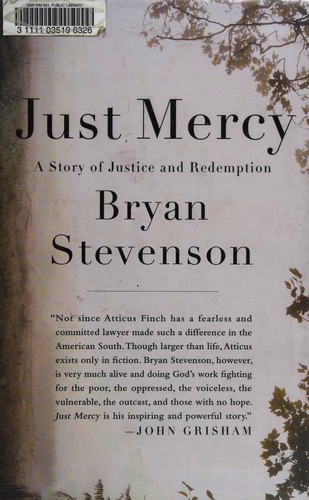
Talk to Just Mercy: A Story of Justice and Redemption like its author wrote you back.
Get the ideas that fit your life — not generic summaries.
- Chat with the book
- Audiobook-style main ideas
- Adapts to your life and goals
- Helps you take action
Just Mercy: A Story of Justice and Redemption, in detail
Bryan Stevenson's memoir of his career as a capital defense attorney in Alabama, and specifically of his years working on the case of Walter McMillian — a Black man wrongly convicted of murder and sentenced to death in Monroe County, Alabama — is simultaneously a riveting legal narrative and a sustained moral argument about the American criminal justice system's treatment of the poor and of Black defendants. Published in 2014, it became one of the most widely assigned books in American college courses and the basis for a 2019 film.
Stevenson was a Harvard Law School graduate who, instead of joining a corporate firm, moved to Alabama in the late 1980s to work on death penalty cases for defendants who had no other legal representation. The McMillian case became his most important: Walter McMillian was an African American man with no criminal record who had been convicted of murdering a white woman in a trial that had multiple witnesses placing him elsewhere, evidence of prosecutorial misconduct, and a coerced false testimony from the actual perpetrator. He had spent years on death row before Stevenson took his case.
The legal work — gathering evidence, interviewing witnesses, filing appeals, managing the slow machinery of post-conviction review — is rendered with enough detail that readers understand both the specific legal obstacles and the systemic ones. Alabama's criminal justice system in the 1990s was responsive to racial and political pressures in ways that made winning McMillian's freedom extraordinarily difficult even with compelling evidence of innocence. Stevenson's account of the county's attitudes, the prosecutor's stonewalling, and the eventual breakthrough is as gripping as fiction.
The book alternates between the McMillian case and other cases Stevenson and the Equal Justice Initiative worked on, including children sentenced to life without parole, a mentally ill woman on death row, and a veteran with PTSD sentenced to death for a crime committed during an episode of acute mental illness. These additional cases broaden the argument from the specific injustice of Walter McMillian's wrongful conviction to the systemic features of a criminal justice system that Stevenson argues is incapable of producing justice for the poor, the Black, the mentally ill, and the young.
The big ideas
- 1.
Proximity to suffering creates moral clarity. Stevenson argues that the most important thing one can do is to get proximate to people who are suffering — that distance allows comfortable abstraction, and closeness creates obligation.
- 2.
Wrongful conviction is not an anomaly. The McMillian case is presented as an extreme instance of widespread structural failures: inadequate counsel, prosecutorial misconduct, racial bias in jury selection, coerced testimony.
- 3.
Children are not adults. One of the book's major advocacy arguments concerns the sentencing of children as adults to life without parole — a practice the Supreme Court later restricted in part because of briefs filed by the Equal Justice Initiative.
