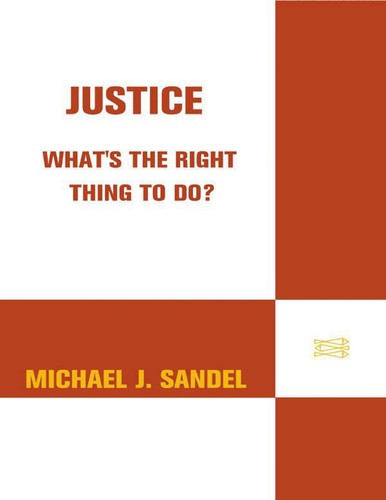
Justice: What's the Right Thing to Do? by Michael J. Sandel is a 2009 philosophy book about justice, moral philosophy, political theory. Three main frameworks structure moral philosophy: utilitarianism (maximize welfare), deontology (respect rights regardless of outcomes), and virtue ethics (ask what the good life and a good society require).
Summary
Justice: What's the Right Thing to Do? grew out of Michael Sandel's famous introductory ethics course at Harvard, which became one of the most watched lecture series in university history. The book is a guided tour of the three major frameworks in moral and political philosophy — utilitarianism, libertarianism, and virtue ethics — tested against real moral dilemmas from affirmative action and same-sex marriage to financial bailouts and wartime service.
Sandel begins with utilitarianism, the view that the right action maximizes overall welfare. He shows how powerful the framework is — and where it breaks down. Torturing one person to save five hundred raises the utilitarian calculus but outrages the intuition that some individuals have rights that can't be bargained away. He then covers Kant's deontological ethics, which grounds rights in the idea that persons must never be treated merely as means, and examines Rawls's theory of justice behind the veil of ignorance as a modern Kantian alternative.
The second half of the book is Sandel's own argument. He argues that neither utilitarian nor Kantian frameworks can fully account for what justice requires, because both try to be neutral about what a good life looks like. Sandel draws on Aristotle to argue that justice is inseparable from questions about the good life and civic virtue. To reason about justice, we must reason about purpose — the purpose of social institutions, goods, and practices. This brings contested moral and religious questions back into public deliberation rather than bracketing them.
The book is explicitly pedagogical and moves through complex material with clarity. Sandel does not hide his own view — he finds Aristotelian civic republicanism more compelling than liberal neutrality — but he presents opposing positions generously. The result is a first-rate introduction to moral philosophy that also constitutes a genuine argument about how democracies should reason together.
Talk to Justice: What's the Right Thing to Do? like its author wrote you back.
Get the ideas that fit your life — not generic summaries.
- Chat with the book
- Audiobook-style main ideas
- Adapts to your life and goals
- Helps you take action
Key takeaways
- 1.
Three main frameworks structure moral philosophy: utilitarianism (maximize welfare), deontology (respect rights regardless of outcomes), and virtue ethics (ask what the good life and a good society require).
- 2.
Utilitarianism's chief weakness is that it allows sacrificing individuals for aggregate gain. Its chief strength is that it takes everyone's welfare seriously.
- 3.
Kant argues morality is grounded in reason and respect for persons as ends in themselves, never merely means. This rules out using people instrumentally even for good outcomes.
- 4.
Rawls asks what principles of justice we'd choose if we didn't know our place in society. His answer — equal basic liberties plus the difference principle — updates Kantian ethics for modern conditions.
- 5.
Sandel argues that liberal neutrality fails: politics cannot be conducted without some account of the good life, and pretending otherwise smuggles in contested assumptions.
- 6.
Aristotle's teleological framework asks: what is the purpose of this institution or practice? Allocating goods well means allocating them to those who will use them for the right ends.
- 7.
Affirmative action and debates about admission reveal that we hold competing implicit theories of merit, purpose, and what universities are for.
- 8.
Moral obligations can arise from membership in communities and histories, not just from voluntary consent — a challenge to libertarian and contractarian views.
Discussion questions
Use these on your own, with a book club, or as chat starters in Superbook. Book club version, ready to copy or print →
- 1.
Sandel says we can't avoid reasoning about the good life when we reason about justice. Do you agree, or do you think liberal neutrality is possible in principle?
- 2.
Think of a real policy debate — healthcare, taxation, immigration. Which of the three frameworks — utilitarian, Kantian, virtue-based — most shapes your own intuitions about it?
- 3.
The trolley problem separates two versions of utilitarian reasoning. Does the distinction between pulling a lever and pushing someone onto tracks feel morally significant to you? Why?
- 4.
Rawls's veil of ignorance is designed to produce fair principles by stripping out self-interest. Does ignorance of your position really produce fairness, or does it just produce risk-aversion?
- 5.
Sandel argues that markets can corrupt certain goods — that some things should not be for sale. What are two or three examples from your own experience where marketization felt wrong?
- 6.
Kant insists moral worth comes from acting from duty, not inclination. If someone is generous by nature, does their generosity count morally? What do you make of Kant's answer?
- 7.
Sandel argues that communal obligations can bind us without our consent. Do you feel obligations to your country, your profession, or your ancestors that you didn't choose?
- 8.
The book defends a more robust civic republicanism. Does that vision feel achievable in politically polarized societies, or is liberal neutrality a necessary compromise?
- 9.
Military service and civic obligation: Sandel argues a just war may require more than a professional army drawn from those with fewer options. What do you think a just military obligation looks like?
- 10.
Sandel draws on Aristotle's notion that institutions have purposes and goods should honor those purposes. Apply this to one institution you know well — a school, a firm, a hospital. Does purpose determine fair distribution within it?
- 11.
Who in public life do you consider a genuinely good public reasoner — someone who engages hard moral questions rather than avoiding them? What makes them distinctive?
- 12.
Sandel ends by calling for a politics of the common good. What would that look like in practice, and what would it require people to give up?
Themes
Frequently asked questions
-
Is Justice by Sandel a good introduction to philosophy?
Yes, it is one of the best introductions to moral and political philosophy for non-specialists. Sandel builds from concrete cases to abstract principles, keeps the writing clear, and doesn't require prior background.
-
What is Sandel's own view of justice?
Sandel leans toward an Aristotelian civic republicanism — the view that justice requires reasoning about the good life and civic virtue, not pretending public life can be neutral about these questions.
-
How is this different from reading Rawls or Kant directly?
Sandel's book is far more accessible and makes the arguments from real examples. It also tells you where those frameworks fail, which primary texts don't do. After reading Sandel, primary texts like A Theory of Justice are much easier to approach.
-
Who should read this book?
Anyone interested in ethics, law, or political theory. It rewards both students encountering these ideas for the first time and professionals — lawyers, doctors, policymakers — who encounter justice questions practically without always having the philosophical vocabulary for them.
-
Does the book take a political side?
Sandel argues against both libertarianism and uncritical utilitarianism. His positive view draws on communitarian and republican traditions. He is critical of market reasoning as the default framework, which some readers find left-leaning, though his framework doesn't map neatly onto party politics.
Similar books
Being and Nothingness
Jean-Paul Sartre

The Republic
Plato
Nicomachean Ethics
Aristotle
The Righteous Mind: Why Good People Are Divided by Politics and Religion
Jonathan Haidt
