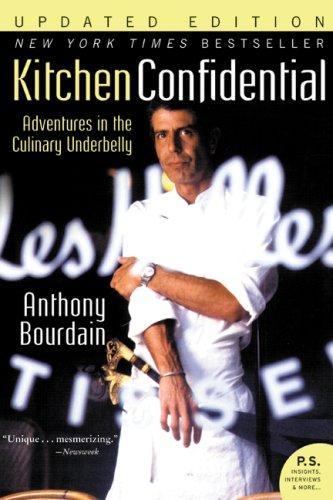
Talk to Kitchen Confidential: Adventures in the Culinary Underbelly like its author wrote you back.
Get the ideas that fit your life — not generic summaries.
- Chat with the book
- Audiobook-style main ideas
- Adapts to your life and goals
- Helps you take action
Kitchen Confidential: Adventures in the Culinary Underbelly, in detail
Kitchen Confidential began as an essay in The New Yorker in 1999. Expanded into a book the following year, it became one of the most widely read food memoirs ever published — not because it celebrates food, but because it describes the people who make food professionally, with a candor that the industry had never really subjected itself to before. Anthony Bourdain, at the time the executive chef at Brasserie Les Halles in Manhattan, wrote about kitchen culture from inside it, and what he described was not glamorous.
The memoir covers Bourdain's early obsession with food — traced to a childhood trip to France, a first raw oyster at sea — through his years as a line cook and eventual chef in New York's restaurant world. It covers his heroin addiction, his years of professional instability, the specific culture of the kitchen as a workplace: hierarchical, brutal, intensely bonding, often deliberately dysfunctional, and staffed by people who chose it in part because it operated outside the norms of conventional employment.
The book made Bourdain a celebrity, which he acknowledged was its own irony — a chef who had spent years in obscurity discovering that candor about that obscurity was worth more than the obscurity itself had been. It also made him a kind of cultural authority on restaurant culture in the United States, an authority he deployed with characteristic skepticism about its own premises.
Kitchen Confidential is uneven in the way of books assembled quickly from a life lived faster. Some chapters are essential; a few are filler. The voice — urgent, profane, self-deprecating, occasionally grandiose — is what sustains it. Bourdain was a gifted writer as well as a gifted cook, and the book is most alive in the moments where those two skills converge: when he's describing the specific pleasure of an unremarked professional task done perfectly, or the specific horror of a kitchen that has stopped caring.
The big ideas
- 1.
Restaurant kitchens are high-pressure, hierarchical workplaces with their own culture, language, and social rules that are largely invisible to the people eating the food produced in them.
- 2.
Bourdain's heroin addiction was not incidental to his career but concurrent with much of it — a fact that complicates both the heroism and the blame in the standard story of professional success.
- 3.
The brigade system — the French military hierarchy of restaurant kitchens — creates intense loyalty and enables abuse simultaneously. Bourdain treats both without pretending one cancels the other.
