Kitchen Confidential: Adventures in the Culinary Underbelly by Anthony Bourdain is a 2000 memoir book about food, work culture, addiction. Restaurant kitchens are high-pressure, hierarchical workplaces with their own culture, language, and social rules that are largely invisible to the people eating the food produced in them.
Summary
Kitchen Confidential began as an essay in The New Yorker in 1999. Expanded into a book the following year, it became one of the most widely read food memoirs ever published — not because it celebrates food, but because it describes the people who make food professionally, with a candor that the industry had never really subjected itself to before. Anthony Bourdain, at the time the executive chef at Brasserie Les Halles in Manhattan, wrote about kitchen culture from inside it, and what he described was not glamorous.
The memoir covers Bourdain's early obsession with food — traced to a childhood trip to France, a first raw oyster at sea — through his years as a line cook and eventual chef in New York's restaurant world. It covers his heroin addiction, his years of professional instability, the specific culture of the kitchen as a workplace: hierarchical, brutal, intensely bonding, often deliberately dysfunctional, and staffed by people who chose it in part because it operated outside the norms of conventional employment.
The book made Bourdain a celebrity, which he acknowledged was its own irony — a chef who had spent years in obscurity discovering that candor about that obscurity was worth more than the obscurity itself had been. It also made him a kind of cultural authority on restaurant culture in the United States, an authority he deployed with characteristic skepticism about its own premises.
Kitchen Confidential is uneven in the way of books assembled quickly from a life lived faster. Some chapters are essential; a few are filler. The voice — urgent, profane, self-deprecating, occasionally grandiose — is what sustains it. Bourdain was a gifted writer as well as a gifted cook, and the book is most alive in the moments where those two skills converge: when he's describing the specific pleasure of an unremarked professional task done perfectly, or the specific horror of a kitchen that has stopped caring.
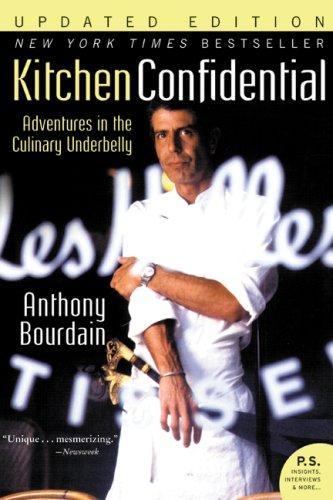
Talk to Kitchen Confidential: Adventures in the Culinary Underbelly like its author wrote you back.
Get the ideas that fit your life — not generic summaries.
- Chat with the book
- Audiobook-style main ideas
- Adapts to your life and goals
- Helps you take action
Key takeaways
- 1.
Restaurant kitchens are high-pressure, hierarchical workplaces with their own culture, language, and social rules that are largely invisible to the people eating the food produced in them.
- 2.
Bourdain's heroin addiction was not incidental to his career but concurrent with much of it — a fact that complicates both the heroism and the blame in the standard story of professional success.
- 3.
The brigade system — the French military hierarchy of restaurant kitchens — creates intense loyalty and enables abuse simultaneously. Bourdain treats both without pretending one cancels the other.
- 4.
Craft matters deeply to Bourdain, and the book is most admiring of people who take the technical work seriously regardless of their other failings.
- 5.
The famous 'never order fish on Monday' advice, and similar revelations about food service practices, is less a consumer guide and more a symptom: it takes years of proximity to understand what you're actually eating.
- 6.
The people drawn to restaurant work are often drawn specifically by its outsider culture — the late hours, the intensity, the tolerance for dysfunction that other workplaces would not absorb.
- 7.
Bourdain's early experiences of transformative food — the oyster, France at eight — suggest that taste is formed early and that proximity to quality at a critical moment has lasting effects.
- 8.
Success in Bourdain's account is not linear. He spent years as a capable but unremarkable cook before finding both his professional footing and his voice as a writer.
Discussion questions
Use these on your own, with a book club, or as chat starters in Superbook. Book club version, ready to copy or print →
- 1.
Bourdain describes kitchen culture as both oppressive and genuinely appealing. What does it offer people that conventional workplaces don't?
- 2.
The book is explicit about his drug use alongside his professional life. How does that change the story of someone succeeding at their craft?
- 3.
Bourdain's voice is candid to the point of recklessness. Did his frankness feel like honesty, performance, or both?
- 4.
The book was controversial in the restaurant industry at the time. What do you think the people he described felt about seeing their world in print?
- 5.
Bourdain traces his love of food to specific childhood experiences. What early encounter with food, or any craft, shaped your own relationship to it?
- 6.
The brigade system creates a clear hierarchy in the kitchen. What are the genuine virtues of that kind of structure, and what does it make possible and impossible?
- 7.
Bourdain says the best meal he ever had was simple — bread and butter in France at age eight. What does that reveal about what food actually is, beneath the professional apparatus around it?
- 8.
The book made Bourdain famous in a way his actual cooking never had. How do you read his relationship to that irony?
- 9.
Kitchen Confidential is partly a book about labor — about the invisible work that goes into the food people eat without thinking about it. What does it make you think about the people who prepare your food?
- 10.
Which parts of the book aged better and which parts aged worse? What does the answer reveal about what has and hasn't changed in food culture?
- 11.
Bourdain is harsh about certain kinds of home cooking and food media. Is that criticism fair, or is it the protectionism of a professional guild?
- 12.
Knowing what you know about how Bourdain's life ended, does that affect how you read the book's energy and restlessness?
Themes
Frequently asked questions
-
Is Kitchen Confidential worth reading?
Yes, especially if you're curious about how restaurants actually work or interested in candid professional memoir. The voice is genuinely compelling and the insider knowledge is specific rather than vague. Some chapters are filler, but the core of the book is exceptional.
-
How long does it take to read Kitchen Confidential?
Around six hours for the 312-page book. Bourdain's prose moves quickly and the chapters are short. It reads easily in a weekend, and many people report finishing it in a single sitting.
-
What is Kitchen Confidential actually about?
It's a memoir about Bourdain's career as a chef — from obsessive childhood food experiences through addiction, professional struggle, and eventual recognition — and also a cultural study of the restaurant kitchen as a particular kind of workplace.
-
Is the advice in Kitchen Confidential still accurate?
Some of it, like the Monday fish warning, has dated as food safety standards and supply chains have changed. Other observations about kitchen culture remain accurate. The book is better read as memoir and cultural portrait than as a practical guide to eating out.
-
Who should read Kitchen Confidential?
Anyone interested in food, professional culture, or candid memoir. It appeals particularly to people who work in restaurants or have, and to anyone drawn to voices that don't perform decorum. It is not for readers who prefer their subjects sympathetically handled.
Similar books
A Moveable Feast
Ernest Hemingway

A Heartbreaking Work of Staggering Genius
Dave Eggers
Born a Crime: Stories from a South African Childhood
Trevor Noah

Wild: From Lost to Found on the Pacific Crest Trail
Cheryl Strayed
