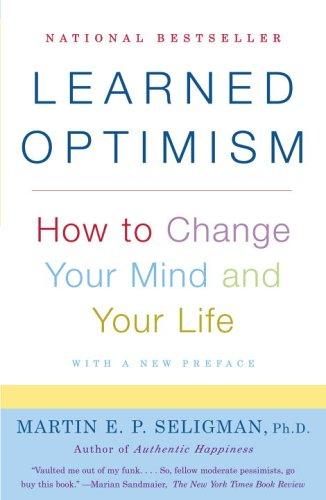
Talk to Learned Optimism: How to Change Your Mind and Your Life like its author wrote you back.
Get the ideas that fit your life — not generic summaries.
- Chat with the book
- Audiobook-style main ideas
- Adapts to your life and goals
- Helps you take action
Learned Optimism: How to Change Your Mind and Your Life, in detail
Martin Seligman's research career began with learned helplessness — the discovery that animals and humans who experience uncontrollable events generalize the uncontrollability to subsequent situations where control is actually possible, becoming passive even when action would help. This led to his interest in the opposite pattern: some people exposed to the same uncontrollable events do not become helpless. They persist. Learned Optimism, published in 1991, is his account of what distinguishes them.
The distinguishing factor is explanatory style — the characteristic way a person explains bad events to themselves. Pessimists explain bad events as permanent ("it's always going to be this way"), pervasive ("it ruins everything"), and personal ("it's my fault"). Optimists explain them as temporary ("this will pass"), specific ("it's just this situation"), and external when appropriate ("that was a combination of factors"). This three-dimensional model — permanence, pervasiveness, and personalization — predicts depression, achievement, health, and persistence across a wide range of studies.
The book makes two arguments: first, that optimism is learnable, not simply a disposition you either have or don't; second, that learning it involves changing explanatory style through cognitive restructuring — the same tool used in Aaron Beck's cognitive therapy for depression. Seligman provides detailed exercises for identifying and disputing pessimistic automatic thoughts, and he includes assessments that let readers establish their own explanatory style as a baseline.
The book also acknowledges the limits of optimism. Pessimistic thinking is often more accurate — what Seligman calls depressive realism. There are situations where optimism leads to overconfidence, excessive risk-taking, and failure to prepare for genuine dangers. The book ends with a framework for choosing when to deploy optimism and when to trust pessimism — when the cost of failure is high and the benefit of optimism is low, accurate assessment beats positive thinking.
The big ideas
- 1.
Explanatory style — the habitual way you explain bad events — predicts depression, achievement, and resilience. Pessimists explain bad events as permanent, pervasive, and personal.
- 2.
Optimistic explanatory style treats bad events as temporary, specific, and externally influenced. This protects against helplessness and maintains motivation for action.
- 3.
Learned helplessness is the generalization of uncontrollability from past experience to current situations. Once established, it becomes a cognitive lens that filters out evidence of control.
