Learned Optimism: How to Change Your Mind and Your Life by Martin E. P. Seligman is a 1991 psychology book about optimism, explanatory style, depression. Explanatory style — the habitual way you explain bad events — predicts depression, achievement, and resilience. Pessimists explain bad events as permanent, pervasive, and personal.
Summary
Martin Seligman's research career began with learned helplessness — the discovery that animals and humans who experience uncontrollable events generalize the uncontrollability to subsequent situations where control is actually possible, becoming passive even when action would help. This led to his interest in the opposite pattern: some people exposed to the same uncontrollable events do not become helpless. They persist. Learned Optimism, published in 1991, is his account of what distinguishes them.
The distinguishing factor is explanatory style — the characteristic way a person explains bad events to themselves. Pessimists explain bad events as permanent ("it's always going to be this way"), pervasive ("it ruins everything"), and personal ("it's my fault"). Optimists explain them as temporary ("this will pass"), specific ("it's just this situation"), and external when appropriate ("that was a combination of factors"). This three-dimensional model — permanence, pervasiveness, and personalization — predicts depression, achievement, health, and persistence across a wide range of studies.
The book makes two arguments: first, that optimism is learnable, not simply a disposition you either have or don't; second, that learning it involves changing explanatory style through cognitive restructuring — the same tool used in Aaron Beck's cognitive therapy for depression. Seligman provides detailed exercises for identifying and disputing pessimistic automatic thoughts, and he includes assessments that let readers establish their own explanatory style as a baseline.
The book also acknowledges the limits of optimism. Pessimistic thinking is often more accurate — what Seligman calls depressive realism. There are situations where optimism leads to overconfidence, excessive risk-taking, and failure to prepare for genuine dangers. The book ends with a framework for choosing when to deploy optimism and when to trust pessimism — when the cost of failure is high and the benefit of optimism is low, accurate assessment beats positive thinking.
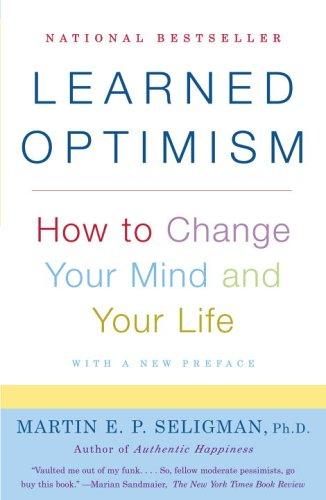
Talk to Learned Optimism: How to Change Your Mind and Your Life like its author wrote you back.
Get the ideas that fit your life — not generic summaries.
- Chat with the book
- Audiobook-style main ideas
- Adapts to your life and goals
- Helps you take action
Key takeaways
- 1.
Explanatory style — the habitual way you explain bad events — predicts depression, achievement, and resilience. Pessimists explain bad events as permanent, pervasive, and personal.
- 2.
Optimistic explanatory style treats bad events as temporary, specific, and externally influenced. This protects against helplessness and maintains motivation for action.
- 3.
Learned helplessness is the generalization of uncontrollability from past experience to current situations. Once established, it becomes a cognitive lens that filters out evidence of control.
- 4.
Explanatory style can be changed through cognitive restructuring: identifying the automatic pessimistic thought, evaluating the evidence for and against it, and generating a more accurate explanation.
- 5.
Depressive realism is real: mildly depressed people are often more accurate in assessing their control and impact than non-depressed people. Optimism involves a positive illusion that motivates action.
- 6.
Optimism is not always better. When the cost of failure is high and the benefit of optimism is limited, accurate assessment outperforms positive thinking. Medical diagnosis, legal risk, and engineering safety are cases where pessimism is appropriate.
- 7.
Prevention of depression in children is possible by teaching optimistic explanatory style. Programs that identify pessimistic children and teach cognitive restructuring reduce rates of depression by early adolescence.
Discussion questions
Use these on your own, with a book club, or as chat starters in Superbook. Book club version, ready to copy or print →
- 1.
Seligman describes your explanatory style as a relatively stable characteristic. Can you identify your own default style for explaining bad events — permanent or temporary, pervasive or specific?
- 2.
The learned helplessness concept emerged from animal experiments where dogs stopped trying to escape shocks they had previously learned were uncontrollable. Where in your life have you stopped trying in a situation where effort would actually help?
- 3.
He acknowledges that pessimists are often more accurate. Can you identify a domain in your life where optimism has led you to underestimate a real risk?
- 4.
The cognitive restructuring exercises involve disputing pessimistic automatic thoughts. Have you practiced anything like this, formally or informally? What happened?
- 5.
Seligman argues that children can be taught optimistic explanatory style and that this reduces depression. What would it mean to make that a serious educational priority?
- 6.
The distinction between when to use optimism and when to trust pessimism is one of the book's most nuanced contributions. Can you think of a current decision in your life where that distinction matters?
- 7.
He argues that chronic explanatory style is partly heritable and partly formed by early experience, particularly parental explanatory style. What do you notice about your own parents' style and your own?
- 8.
Learned Optimism was published in 1991, predating the positive psychology movement Seligman later founded. How does the earlier, more clinical book feel different from the later prescriptive work?
- 9.
The book includes self-assessments. Did you find the assessments in the book useful, or do you trust your intuitions about your own explanatory style more?
- 10.
Seligman acknowledges that some pessimism is protective and accurate. How do you decide which of your negative thoughts to dispute and which to take seriously?
- 11.
If you were designing a school curriculum to build resilience, what would you include based on this book's framework?
Themes
Frequently asked questions
-
What is explanatory style?
The characteristic way a person explains the causes of events that happen to them. Seligman identifies three dimensions: permanence (temporary vs. permanent), pervasiveness (specific vs. universal), and personalization (external vs. internal). Optimists and pessimists differ systematically across all three.
-
What is the ABCDE technique?
Adversity, Belief, Consequence, Disputation, Energization — a cognitive restructuring method Seligman teaches for changing pessimistic automatic thoughts. You identify the adverse event, notice the automatic belief about its cause, observe the emotional consequence, dispute the pessimistic belief with evidence, and note the energizing effect of the successful disputation.
-
What is depressive realism?
The finding that mildly depressed people are often more accurate in assessing their control over outcomes than non-depressed people. Non-depressed people maintain positive illusions that motivate them even when inaccurate. Seligman uses this to argue that optimism is useful because it motivates, not because it is more accurate.
-
Is this book still useful today?
Yes. The explanatory style research has held up and the cognitive restructuring tools are evidence-based. Cognitive behavioral therapy, which draws on similar principles, is one of the most validated psychological interventions available.
-
Does optimism actually cause better outcomes?
It is associated with better outcomes across many domains, and there is some experimental evidence that changing explanatory style improves outcomes. Whether the association is causal or reflects other factors remains debated, but the direction of evidence is consistently positive for optimistic style.
Similar books
Flourish: A Visionary New Understanding of Happiness and Well-being
Martin E. P. Seligman

Man's Search for Meaning
Viktor E. Frankl
The Happiness Hypothesis
Jonathan Haidt

Mindset: The New Psychology of Success
Carol S. Dweck
