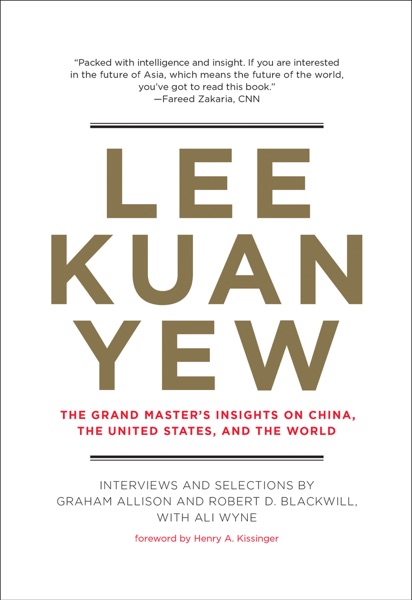
Talk to Lee Kuan Yew: The Grand Master's Insights like its author wrote you back.
Get the ideas that fit your life — not generic summaries.
- Chat with the book
- Audiobook-style main ideas
- Adapts to your life and goals
- Helps you take action
What it argues
Lee Kuan Yew: The Grand Master's Insights compiles the views of Singapore's founding prime minister on the major strategic questions of the early twenty-first century. The book's editors — Graham Allison and Robert Blackwill of Harvard's Belfer Center, with Ali Wyne — organized Lee's statements and interviews around eight questions: the future of China, the United States, relations between the two powers, India, Islamic extremism, geopolitics, democracy and governance, and Lee's own leadership philosophy.
Lee's voice is the book's main draw. He was widely considered one of the most clear-eyed strategic analysts of his era — a leader who had taken a resource-poor island from third world to first world in a single generation and who had observed the full sweep of Cold War and post-Cold War geopolitics from a vantage point that few Western leaders matched. His assessments are blunt: China's rise is real and will reshape the international order, but the Chinese Communist Party's need for legitimacy through economic performance is a structural constraint on how it exercises power. America's decline relative to Asia is real but not terminal, provided Washington maintains the institutional and educational foundations that enable innovation.
What it gets right
- 1.
China's rise is structural and will reshape the global order. Lee viewed it as the most significant geopolitical shift of the twenty-first century, comparable to the emergence of the United States as a great power.
- 2.
The Chinese Communist Party's legitimacy depends on continued economic growth. This creates a genuine constraint on Chinese adventurism — leaders who destabilize the economy undermine their own position.
- 3.
America remains formidable because of its institutions, universities, and culture of innovation — but its political dysfunction and inability to execute long-term strategy are real vulnerabilities.
What it covers
Who wrote it
Graham Allison is a political scientist and professor at Harvard's John F. Kennedy School of Government, where he was the founding dean of the Belfer Center for Science and International Affairs. He is the author of Destined for War: Can America and China Escape Thucydides's Trap? and has advised multiple US administrations on national security matters. Robert Blackwill is a former US ambassador and NSC official. The book draws primarily on Lee Kuan Yew's own statements, compiled with extensive editorial annotation.
