Talk to Legends & Lattes like its author wrote you back.
Get the ideas that fit your life — not generic summaries.
- Chat with the book
- Audiobook-style main ideas
- Adapts to your life and goals
- Helps you take action
Legends & Lattes, in detail
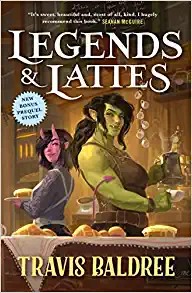
Viv is an orc barbarian who has spent decades killing things for coin. At the peak of her fighting career she decides she's done — she wants to open a coffee shop. Nobody in the city of Thune has ever heard of coffee, and the city doesn't especially want an orc running a business in its commercial district. Legends & Lattes is about what comes after the adventure: building something instead of destroying it, finding where you belong when you've spent your whole life in motion.
The book works less as a fantasy story and more as a slow domestic drama with fantasy furniture. The central tensions are mundane: will the shop survive? Will the regulars keep coming back? Will Viv let herself be loved by the people around her, or keep treating every relationship like a temporary bivouac? Baldree is less interested in plot twists than in the texture of daily routine — the smell of baking, the regulars who become fixtures, the found family that assembles itself around a warm room.
"Cozy fantasy" is the genre label that attached itself to this book, and it fits, though Baldree earns the coziness. There's real loneliness under the surface. Viv is a person who has never learned how to want small things, and watching her figure it out — haltingly, sometimes self-sabotaging — gives the sweetness weight. The queer romance is written without drama or apology; it's one of the few recent fantasies where a relationship between women is simply the relationship, not the conflict. The prose is unpretentious and moves quickly.
Readers who want escalating stakes and world-threatening danger will bounce off this. The book's appeal is to people who have had enough of that kind of story — or who are tired right now and want something that insists, gently, that small pleasures and the people you make coffee for are a sufficient reason to keep going. It sits comfortably next to A Psalm for the Wild-Built in the "fantasy about rest and meaning" category, and for the right reader it lands harder.
The big ideas
- 1.
The book insists that quitting an identity you've outgrown is an act of courage, not failure — Viv walking away from adventuring is treated as the bravest thing she does.
- 2.
Found family forms around shared space and repeated presence, not dramatic declarations. The regulars at the coffee shop become a family by showing up.
- 3.
The queer romance is notable for what it refuses to do: make queer identity a source of external conflict. It's simply there, central and undramatic.
