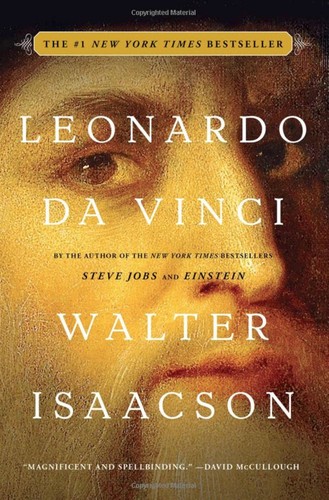
Talk to Leonardo da Vinci like its author wrote you back.
Get the ideas that fit your life — not generic summaries.
- Chat with the book
- Audiobook-style main ideas
- Adapts to your life and goals
- Helps you take action
What it argues
Walter Isaacson's biography of Leonardo da Vinci is built around a simple and provocative claim: Leonardo's genius was not a supernatural gift but an extreme version of a learnable quality — curiosity. Isaacson spent years with Leonardo's notebooks, thousands of pages of drawings, observations, lists, and experiments that Leonardo never published and few have read closely. Those notebooks are the backbone of the book, and they paint a picture of someone who could not look at a shadow, a river, a human lip, or a swallow in flight without stopping to understand exactly how it worked.
Leonardo's life had long gaps and famous failures. He left many major commissions unfinished — the Adoration of the Magi, the bronze horse in Milan — chasing the next question instead of completing the current project. He spent years studying optics, anatomy, hydraulics, geology, and botany, and very little of that research made it into finished artwork. Isaacson treats this not as weakness but as the other side of the same trait: the man who couldn't stop asking questions also couldn't stop starting new ones. The Mona Lisa took sixteen years, which is one interpretation of what perfectionism looks like at full scale.
What it gets right
- 1.
Leonardo's genius was more about insatiable curiosity and relentless observation than innate talent. He wrote in his notebooks 'I wish to work miracles' — then spent his life doing the actual observational work.
- 2.
His notebooks reveal thousands of questions and very few answers, suggesting that he found the act of inquiry intrinsically valuable, not just instrumental.
- 3.
The unfinished projects that frustrated patrons were the same as the endless curiosity that produced his scientific breakthroughs — two sides of the same trait.
What it covers
Who wrote it
Walter Isaacson is an American author, journalist, and former CEO of the Aspen Institute. He has written bestselling biographies of Steve Jobs, Albert Einstein, Benjamin Franklin, and Henry Kissinger, as well as The Innovators, a history of the digital revolution. He was managing editor of Time magazine and chairman of CNN before turning to full-time writing. His biographies are known for their narrative accessibility and broad research base, including extensive primary sources. He is a professor at Tulane University.
