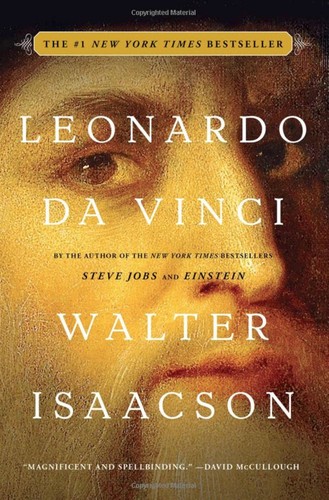
Talk to Leonardo da Vinci like its author wrote you back.
Get the ideas that fit your life — not generic summaries.
- Chat with the book
- Audiobook-style main ideas
- Adapts to your life and goals
- Helps you take action
Leonardo da Vinci, in detail
Walter Isaacson's biography of Leonardo da Vinci is built around a simple and provocative claim: Leonardo's genius was not a supernatural gift but an extreme version of a learnable quality — curiosity. Isaacson spent years with Leonardo's notebooks, thousands of pages of drawings, observations, lists, and experiments that Leonardo never published and few have read closely. Those notebooks are the backbone of the book, and they paint a picture of someone who could not look at a shadow, a river, a human lip, or a swallow in flight without stopping to understand exactly how it worked.
Leonardo's life had long gaps and famous failures. He left many major commissions unfinished — the Adoration of the Magi, the bronze horse in Milan — chasing the next question instead of completing the current project. He spent years studying optics, anatomy, hydraulics, geology, and botany, and very little of that research made it into finished artwork. Isaacson treats this not as weakness but as the other side of the same trait: the man who couldn't stop asking questions also couldn't stop starting new ones. The Mona Lisa took sixteen years, which is one interpretation of what perfectionism looks like at full scale.
The biography is most original in its close reading of specific paintings — the Last Supper, the Vitruvian Man, the Virgin of the Rocks — through the lens of what Leonardo actually understood scientifically at the time he made them. Isaacson argues that the sfumato (smoky edge) technique Leonardo pioneered was not just a stylistic choice but a direct application of his observations of how light actually diffuses at the border between objects. Art and science were the same inquiry.
The book is long and occasionally repetitive, as Isaacson traces Leonardo across decades and patrons. But the central argument — that radical, playful, undisciplined curiosity is a habit that anyone can cultivate more of — is made with enough evidence to be genuinely motivating rather than empty inspiration. Leonardo's curiosity extended to things that had no conceivable practical use: he designed costumes, organized theatrical productions, imagined giant crossbows, and once calculated the size of the sun by holding up a small hole on a piece of paper. That breadth is both the point and the model.
The big ideas
- 1.
Leonardo's genius was more about insatiable curiosity and relentless observation than innate talent. He wrote in his notebooks 'I wish to work miracles' — then spent his life doing the actual observational work.
- 2.
His notebooks reveal thousands of questions and very few answers, suggesting that he found the act of inquiry intrinsically valuable, not just instrumental.
- 3.
The unfinished projects that frustrated patrons were the same as the endless curiosity that produced his scientific breakthroughs — two sides of the same trait.
