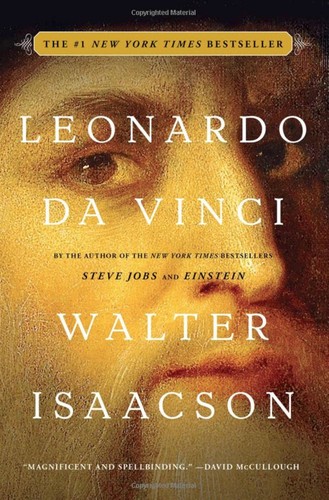
Leonardo da Vinci by Walter Isaacson is a 2017 biography book about creativity, curiosity, art and science. Leonardo's genius was more about insatiable curiosity and relentless observation than innate talent. He wrote in his notebooks 'I wish to work miracles' — then spent his life doing the actual observational work.
Summary
Walter Isaacson's biography of Leonardo da Vinci is built around a simple and provocative claim: Leonardo's genius was not a supernatural gift but an extreme version of a learnable quality — curiosity. Isaacson spent years with Leonardo's notebooks, thousands of pages of drawings, observations, lists, and experiments that Leonardo never published and few have read closely. Those notebooks are the backbone of the book, and they paint a picture of someone who could not look at a shadow, a river, a human lip, or a swallow in flight without stopping to understand exactly how it worked.
Leonardo's life had long gaps and famous failures. He left many major commissions unfinished — the Adoration of the Magi, the bronze horse in Milan — chasing the next question instead of completing the current project. He spent years studying optics, anatomy, hydraulics, geology, and botany, and very little of that research made it into finished artwork. Isaacson treats this not as weakness but as the other side of the same trait: the man who couldn't stop asking questions also couldn't stop starting new ones. The Mona Lisa took sixteen years, which is one interpretation of what perfectionism looks like at full scale.
The biography is most original in its close reading of specific paintings — the Last Supper, the Vitruvian Man, the Virgin of the Rocks — through the lens of what Leonardo actually understood scientifically at the time he made them. Isaacson argues that the sfumato (smoky edge) technique Leonardo pioneered was not just a stylistic choice but a direct application of his observations of how light actually diffuses at the border between objects. Art and science were the same inquiry.
The book is long and occasionally repetitive, as Isaacson traces Leonardo across decades and patrons. But the central argument — that radical, playful, undisciplined curiosity is a habit that anyone can cultivate more of — is made with enough evidence to be genuinely motivating rather than empty inspiration. Leonardo's curiosity extended to things that had no conceivable practical use: he designed costumes, organized theatrical productions, imagined giant crossbows, and once calculated the size of the sun by holding up a small hole on a piece of paper. That breadth is both the point and the model.
Talk to Leonardo da Vinci like its author wrote you back.
Get the ideas that fit your life — not generic summaries.
- Chat with the book
- Audiobook-style main ideas
- Adapts to your life and goals
- Helps you take action
Key takeaways
- 1.
Leonardo's genius was more about insatiable curiosity and relentless observation than innate talent. He wrote in his notebooks 'I wish to work miracles' — then spent his life doing the actual observational work.
- 2.
His notebooks reveal thousands of questions and very few answers, suggesting that he found the act of inquiry intrinsically valuable, not just instrumental.
- 3.
The unfinished projects that frustrated patrons were the same as the endless curiosity that produced his scientific breakthroughs — two sides of the same trait.
- 4.
Leonardo's art was informed by direct scientific investigation. He dissected more than thirty human corpses to understand the anatomy he was painting.
- 5.
His sfumato painting technique was a direct application of his studies of how light and air actually work at the boundaries between objects — art and science were unified inquiry.
- 6.
He had no formal education beyond reading and writing, which Isaacson argues left him free of received orthodoxy — he could observe freshly because he hadn't been trained what to see.
- 7.
Collaboration and patronage shaped his career as much as genius did — his best work came from being embedded in the right ecosystems, from Verrocchio's workshop to Ludovico Sforza's Milan court.
- 8.
The Mona Lisa, the most analyzed painting in history, took sixteen years and was still technically unfinished when Leonardo died — a testament to his belief that perfection was always one more layer away.
Discussion questions
Use these on your own, with a book club, or as chat starters in Superbook. Book club version, ready to copy or print →
- 1.
Isaacson argues Leonardo's curiosity was extreme but learnable. What would it mean in your own life to make a list of questions the way Leonardo did, without worrying whether they are practically useful?
- 2.
Leonardo left dozens of projects unfinished. Is that a failure of discipline or an expression of intellectual integrity? How do you draw that line in your own work?
- 3.
The notebooks were never published in Leonardo's lifetime. How does working without an audience change what someone is willing to explore?
- 4.
Isaacson says Leonardo's lack of formal schooling was an advantage because it meant he had to observe directly rather than inheriting received knowledge. Where in your field might formal training be limiting rather than enabling?
- 5.
Leonardo studied anatomy, geology, and optics not to make better paintings but because he couldn't help it. How much of your learning is genuinely curiosity-driven versus instrumentally motivated?
- 6.
The Mona Lisa's famous quality — the sense that the expression changes when you look from different angles — comes from techniques Leonardo developed through scientific observation. Does knowing that change how you experience the painting?
- 7.
Leonardo worked for powerful and sometimes brutal patrons — the Sforzas, the Medicis, Cesare Borgia — producing work on commission. How did patronage shape what he made? What's the modern equivalent of that tension?
- 8.
Isaacson describes Leonardo's seven decades as a series of relocations — Florence, Milan, Venice, Rome, France — each driven partly by necessity. How do different environments shape creative output?
- 9.
Leonardo made extremely detailed lists of things he wanted to know: 'describe the tongue of a woodpecker,' 'how do you walk on ice.' What would be on your list?
- 10.
The book ends with Leonardo dying in France, having accomplished less than he planned and more than almost anyone in history. How do you think about the relationship between ambition and completion in your own life?
- 11.
Isaacson connects Leonardo's approach directly to modern innovation and creativity. Does that connection feel earned by the book, or like overreach?
- 12.
Which of Leonardo's projects — paintings, engineering, anatomy, theatrical design — seems most alien to how we think about specialization today? What does that tell you?
Themes
Frequently asked questions
-
What is Leonardo da Vinci by Walter Isaacson about?
It's a biography built around Leonardo's notebooks — thousands of pages of drawings and observations — arguing that his genius was an extreme expression of curiosity rather than supernatural talent. Isaacson traces his life from his illegitimate birth in Tuscany through his final years in France.
-
How long does it take to read Leonardo da Vinci?
Around ten to twelve hours for the 500-plus-page book. It's richly illustrated, which affects pacing. The chapters are organized chronologically and thematically, and some readers find it works well to read alongside looking up the paintings and drawings discussed.
-
Is Leonardo da Vinci by Isaacson worth reading?
Yes, especially the sections on specific paintings and the scientific research that informed them. The central argument about curiosity as a habit is made compellingly. At 500 pages it is occasionally repetitive, and some readers find the later chapters slower than the earlier ones.
-
What is the main argument of the book?
That Leonardo's exceptional creativity came from his practice of sustained, undisciplined curiosity across every field — art, anatomy, geology, optics, engineering — and that this quality, while extreme in his case, is something people can consciously cultivate.
-
Who should read Leonardo da Vinci?
People interested in creativity, the Renaissance, or the relationship between art and science. Also useful for anyone who has read Isaacson's other biographies and wants to understand his approach to genius at full length. Not recommended for casual reading — it rewards sustained attention.