Talk to Lessons from the Titans like its author wrote you back.
Get the ideas that fit your life — not generic summaries.
- Chat with the book
- Audiobook-style main ideas
- Adapts to your life and goals
- Helps you take action
Lessons from the Titans, in detail
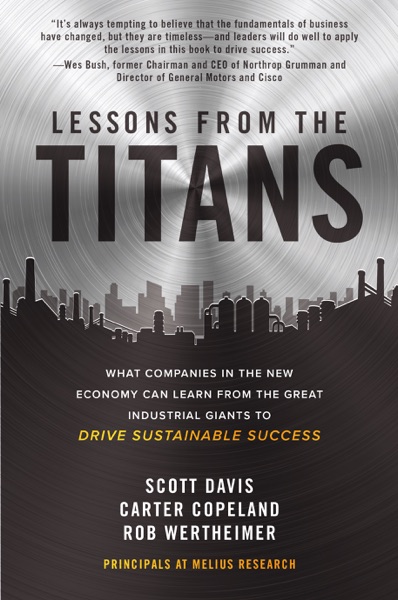
Lessons from the Titans is an equity research team's study of what separates great industrial companies from average ones. Scott Davis, Carter Copeland, and Rob Wertheimer spent years covering industrials at Melius Research and before that at Barclays, and the book distills what they observed across decades of quarterly earnings calls, plant visits, and management interviews with companies including Danaher, Honeywell, General Electric, United Technologies, and 3M.
The central argument is that the industrial sector — boring, capital-intensive, unglamorous — is a richer laboratory for management lessons than Silicon Valley, because industrial companies cannot hide behind growth. A software company can paper over operational mediocrity with revenue expansion. An industrial manufacturer with thin margins and heavy capital requirements has to actually run well, or it dies. The authors argue that the practices developed at the best industrial companies — disciplined capital allocation, continuous improvement systems, rigorous management of operating metrics — are more broadly applicable than the startup-era mantras that dominate most business books.
Each chapter takes a different company as a case study: Danaher's famous Danaher Business System and its acquisition playbook, Honeywell's turnaround under Dave Cote and the concept of "investing in the future while delivering today," General Electric's descent from Jack Welch's financial engineering through Jeff Immelt's diversification failures, and United Technologies' portfolio management under Greg Hayes. The juxtaposition is instructive. The authors are frank about what went wrong at GE and why — the analysis of Welch's legacy and Immelt's tenure is genuinely critical rather than hagiographic.
The book is most useful for investors trying to understand why some industrial companies compound value for decades while others deteriorate, and for managers inside large organizations who want a vocabulary and framework for thinking about operational excellence beyond the clichés. It assumes some familiarity with how public companies work — earnings guidance, capital allocation decisions, acquisition premiums — and readers without that background may find some sections demanding. For those who come prepared, it is a rigorous and unusually honest account of what industrial management actually requires.
The big ideas
- 1.
Industrial companies cannot hide operational mediocrity behind growth; thin margins and heavy capital requirements mean that management quality is directly visible in financial results over time.
- 2.
Danaher's success comes from applying a systematic improvement methodology — the Danaher Business System — to every acquisition, not from being lucky about what it bought.
- 3.
Honeywell's Dave Cote demonstrated that 'investing in the future while delivering today' is a discipline, not a platitude — it requires saying no to short-term pressures continuously.
