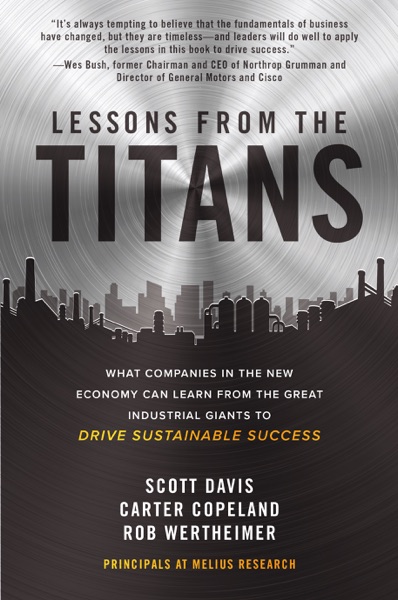
Lessons from the Titans by Scott Davis, Carter Copeland & Rob Wertheimer is a 2020 business book about industrial management, corporate turnaround, operational excellence. Industrial companies cannot hide operational mediocrity behind growth; thin margins and heavy capital requirements mean that management quality is directly visible in financial results over time.
Summary
Lessons from the Titans is an equity research team's study of what separates great industrial companies from average ones. Scott Davis, Carter Copeland, and Rob Wertheimer spent years covering industrials at Melius Research and before that at Barclays, and the book distills what they observed across decades of quarterly earnings calls, plant visits, and management interviews with companies including Danaher, Honeywell, General Electric, United Technologies, and 3M.
The central argument is that the industrial sector — boring, capital-intensive, unglamorous — is a richer laboratory for management lessons than Silicon Valley, because industrial companies cannot hide behind growth. A software company can paper over operational mediocrity with revenue expansion. An industrial manufacturer with thin margins and heavy capital requirements has to actually run well, or it dies. The authors argue that the practices developed at the best industrial companies — disciplined capital allocation, continuous improvement systems, rigorous management of operating metrics — are more broadly applicable than the startup-era mantras that dominate most business books.
Each chapter takes a different company as a case study: Danaher's famous Danaher Business System and its acquisition playbook, Honeywell's turnaround under Dave Cote and the concept of "investing in the future while delivering today," General Electric's descent from Jack Welch's financial engineering through Jeff Immelt's diversification failures, and United Technologies' portfolio management under Greg Hayes. The juxtaposition is instructive. The authors are frank about what went wrong at GE and why — the analysis of Welch's legacy and Immelt's tenure is genuinely critical rather than hagiographic.
The book is most useful for investors trying to understand why some industrial companies compound value for decades while others deteriorate, and for managers inside large organizations who want a vocabulary and framework for thinking about operational excellence beyond the clichés. It assumes some familiarity with how public companies work — earnings guidance, capital allocation decisions, acquisition premiums — and readers without that background may find some sections demanding. For those who come prepared, it is a rigorous and unusually honest account of what industrial management actually requires.
Talk to Lessons from the Titans like its author wrote you back.
Get the ideas that fit your life — not generic summaries.
- Chat with the book
- Audiobook-style main ideas
- Adapts to your life and goals
- Helps you take action
Key takeaways
- 1.
Industrial companies cannot hide operational mediocrity behind growth; thin margins and heavy capital requirements mean that management quality is directly visible in financial results over time.
- 2.
Danaher's success comes from applying a systematic improvement methodology — the Danaher Business System — to every acquisition, not from being lucky about what it bought.
- 3.
Honeywell's Dave Cote demonstrated that 'investing in the future while delivering today' is a discipline, not a platitude — it requires saying no to short-term pressures continuously.
- 4.
General Electric's decline illustrates how financial engineering under Welch built a company that was fragile to the conditions that made that engineering possible, rather than a sustainably excellent business.
- 5.
Capital allocation — deciding what to acquire, what to divest, and when to return cash to shareholders — is the central skill of industrial management, not operational efficiency alone.
- 6.
The best industrial managers measure everything and act on the measurements. Management systems that track leading indicators rather than just lagging financial results give companies time to respond.
- 7.
Acquisition integration is where most industrial roll-up strategies fail. The companies that do it well have a repeatable playbook, not a case-by-case improvisation.
- 8.
Consistency in process and culture outlasts any individual leader. Companies that depend on a single exceptional CEO are exposed when that CEO leaves.
Discussion questions
Use these on your own, with a book club, or as chat starters in Superbook. Book club version, ready to copy or print →
- 1.
The authors argue that industrial companies are better management laboratories than tech companies. Do you find that persuasive? What is lost by studying management through a technology-company lens?
- 2.
Danaher applies the same improvement system to every acquisition it makes. What does that consistency of method require of the people who run Danaher, and what does it prevent?
- 3.
Dave Cote's 'investing in the future while delivering today' formula sounds obvious. What makes it difficult in practice, and what pressures push organizations in the opposite direction?
- 4.
The GE case study is essentially a cautionary tale about Jack Welch's legacy as well as Immelt's. How do you think about crediting or blaming a previous CEO for a company's later problems?
- 5.
Capital allocation is described as the core skill of industrial management. Who in your professional life makes decisions most like capital allocation, and do they think about it systematically?
- 6.
The book is written by equity analysts. How does the investor's perspective on management quality differ from, say, a management consultant's or an operations researcher's?
- 7.
Many of the management principles here — discipline, consistency, measuring what matters — appear in other business books. What does the industrial context add to those ideas?
- 8.
The authors are critical of GE's financial engineering under Welch in a way that most business books of the Welch era were not. What made that critique possible to write after the fact and so difficult during the period?
- 9.
Lessons from the Titans is built on decades of analyst coverage. What kinds of knowledge accumulate from watching a company for fifteen years that can't be captured in a single research report?
- 10.
The book focuses on large, public industrial companies. How much of what it argues applies to smaller private businesses, and what is different?
- 11.
If you were advising a CEO of a mid-size industrial company, which single lesson from the book would you lead with?
Themes
Frequently asked questions
-
Who is this book for?
Investors in industrial companies and managers inside large manufacturing or diversified industrial organizations. It is less useful for startup founders or pure service-sector readers, though the capital allocation and operational discipline principles translate broadly.
-
Do I need to know finance to read Lessons from the Titans?
Some background helps. The book references earnings guidance, acquisition multiples, and return-on-invested-capital analysis in ways that assume familiarity. Readers without finance background can still get the main ideas, but some sections will require supplementary context.
-
What makes Danaher the book's central success story?
Danaher developed a systematic improvement methodology and applied it consistently across hundreds of acquisitions over decades. The result was compounding improvement in margins and returns at every company it bought, which is unusual. Most acquirers destroy value; Danaher reliably created it.
-
Is the GE analysis fair?
The authors argue Welch built GE Capital to a scale that made the entire company fragile to a financial crisis, and that credit for his earnings record belonged partly to financial engineering rather than operating excellence. This is a defensible reading of the evidence, and the authors note where their interpretation differs from the conventional one.
-
How long does the book take to read?
Around five to six hours at average pace. The chapters are structured as standalone case studies, so it can be read non-linearly if you have a particular interest in one company over another.
Similar books
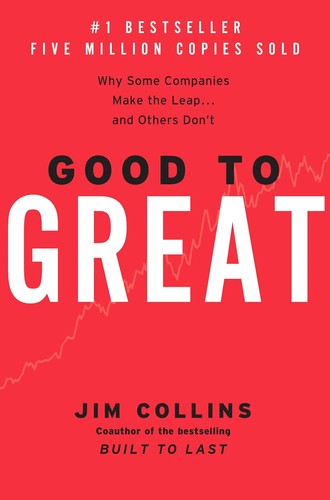
Good to Great
Jim Collins
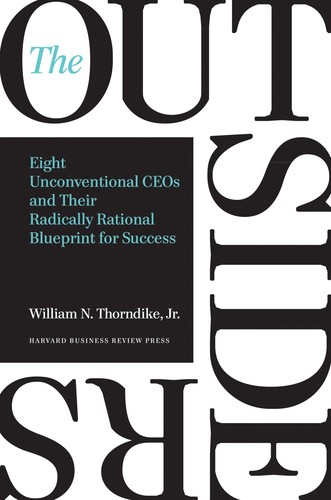
The Outsiders: Eight Unconventional CEOs and Their Radically Rational Blueprint for Success
William N. Thorndike
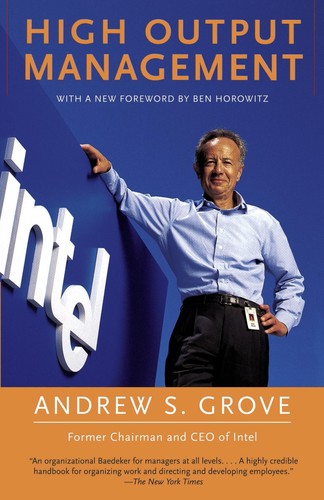
High Output Management
Andrew S. Grove
Only the Paranoid Survive
Andrew S. Grove
