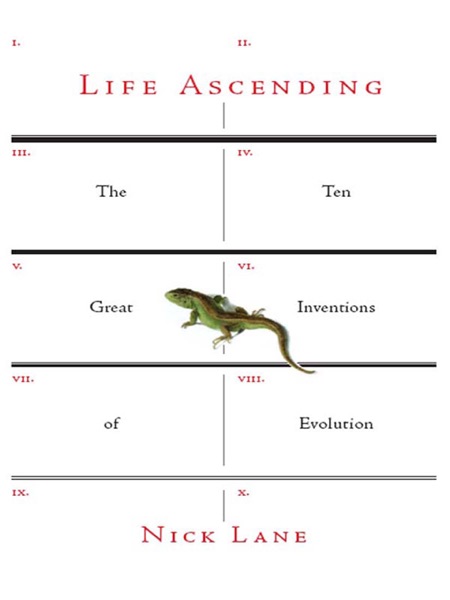
Talk to Life Ascending like its author wrote you back.
Get the ideas that fit your life — not generic summaries.
- Chat with the book
- Audiobook-style main ideas
- Adapts to your life and goals
- Helps you take action
Life Ascending, in detail
Life Ascending is Nick Lane's examination of what he calls evolution's ten greatest inventions: the origin of life itself, DNA, photosynthesis, the complex cell, sex, movement, sight, hot blood, consciousness, and death. Each chapter takes one invention and asks both how it arose and why it matters for understanding life's present form. Lane is a biochemist by training and writes with unusual depth about the chemistry underlying processes that most popular science books treat as black boxes.
The chapter on the origin of life illustrates Lane's approach. Rather than gesturing toward primordial soup and the mystery of self-replication, he walks through the chemistry in detail, focusing on alkaline hydrothermal vents as the likely setting. The argument involves proton gradients, chemiosmosis, and the machinery cells still use to generate energy — the same mechanism powering the mitochondria in every cell of the reader's body. The argument is that life didn't begin in spite of thermodynamic challenges but because of them: the steep energy gradients at vent sites provided the driving force.
The chapter on sex is similarly unorthodox. Lane doesn't primarily address why sex evolved — the conventional puzzle around the cost of males — but instead focuses on why sex involves two sexes rather than ten or one, and why mitochondria are inherited only from mothers. The answer involves genetic conflict between the nuclear and mitochondrial genomes, a story rarely covered at this depth outside specialized literature.
Lane writes for a general audience but doesn't dumb the material down. Some chapters require genuine attention; the cellular respiration sections assume readers are willing to think about chemical mechanisms. What makes the book valuable is the integration: by the end, the ten inventions feel connected, each one built on the molecular logic of the previous ones. Lane's perspective, shaped by his research on mitochondria and the origin of life, is distinctive enough that even readers familiar with popular evolutionary biology will encounter new framing.
The big ideas
- 1.
Life likely originated at alkaline hydrothermal vents, where natural proton gradients provided the energy driving force that modern cells still replicate with their mitochondria.
- 2.
DNA's role is often overstated. The genetic code is near-universal, but the ribosome — the molecular machine that translates DNA into proteins — is arguably equally fundamental and has not changed in two billion years.
- 3.
Photosynthesis split water to release oxygen, and the resulting oxidative atmosphere was initially catastrophic for most life. The Great Oxidation Event was evolution's first mass pollution crisis.
