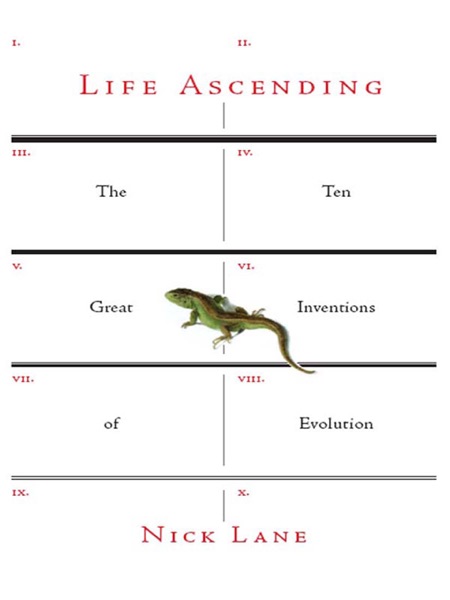
Life Ascending by Nick Lane is a 2009 science book about evolution, origins of life, biochemistry. Life likely originated at alkaline hydrothermal vents, where natural proton gradients provided the energy driving force that modern cells still replicate with their mitochondria.
Summary
Life Ascending is Nick Lane's examination of what he calls evolution's ten greatest inventions: the origin of life itself, DNA, photosynthesis, the complex cell, sex, movement, sight, hot blood, consciousness, and death. Each chapter takes one invention and asks both how it arose and why it matters for understanding life's present form. Lane is a biochemist by training and writes with unusual depth about the chemistry underlying processes that most popular science books treat as black boxes.
The chapter on the origin of life illustrates Lane's approach. Rather than gesturing toward primordial soup and the mystery of self-replication, he walks through the chemistry in detail, focusing on alkaline hydrothermal vents as the likely setting. The argument involves proton gradients, chemiosmosis, and the machinery cells still use to generate energy — the same mechanism powering the mitochondria in every cell of the reader's body. The argument is that life didn't begin in spite of thermodynamic challenges but because of them: the steep energy gradients at vent sites provided the driving force.
The chapter on sex is similarly unorthodox. Lane doesn't primarily address why sex evolved — the conventional puzzle around the cost of males — but instead focuses on why sex involves two sexes rather than ten or one, and why mitochondria are inherited only from mothers. The answer involves genetic conflict between the nuclear and mitochondrial genomes, a story rarely covered at this depth outside specialized literature.
Lane writes for a general audience but doesn't dumb the material down. Some chapters require genuine attention; the cellular respiration sections assume readers are willing to think about chemical mechanisms. What makes the book valuable is the integration: by the end, the ten inventions feel connected, each one built on the molecular logic of the previous ones. Lane's perspective, shaped by his research on mitochondria and the origin of life, is distinctive enough that even readers familiar with popular evolutionary biology will encounter new framing.
Talk to Life Ascending like its author wrote you back.
Get the ideas that fit your life — not generic summaries.
- Chat with the book
- Audiobook-style main ideas
- Adapts to your life and goals
- Helps you take action
Key takeaways
- 1.
Life likely originated at alkaline hydrothermal vents, where natural proton gradients provided the energy driving force that modern cells still replicate with their mitochondria.
- 2.
DNA's role is often overstated. The genetic code is near-universal, but the ribosome — the molecular machine that translates DNA into proteins — is arguably equally fundamental and has not changed in two billion years.
- 3.
Photosynthesis split water to release oxygen, and the resulting oxidative atmosphere was initially catastrophic for most life. The Great Oxidation Event was evolution's first mass pollution crisis.
- 4.
The eukaryotic cell — cells with nuclei and mitochondria — required a fateful merger between an archaeon and a bacterium. That merger happened once in Earth's history and explains why complex life exists at all.
- 5.
Sex evolved partly to resolve genetic conflict between nuclear and mitochondrial genomes. The asymmetry between sexes — sperm versus egg — is a solution to the problem of keeping mitochondria quality-controlled across generations.
- 6.
Warm blood is enormously expensive metabolically but enables constant aerobic activity regardless of environmental temperature. The tradeoff explains why endotherms like mammals and birds have come to dominate many ecological niches.
- 7.
Consciousness remains scientifically unresolved, but Lane argues that its origins in the Cambrian explosion suggest it emerged when brains became complex enough to model other minds — a prerequisite for social behavior in active predators.
- 8.
Death by senescence is not simply wear and tear but a product of selection pressure: genes that benefit reproduction early in life can be harmful later, and evolution has limited leverage to remove them once the organism has already reproduced.
Discussion questions
Use these on your own, with a book club, or as chat starters in Superbook. Book club version, ready to copy or print →
- 1.
Lane argues that each of the ten inventions was improbable but, once achieved, essentially irreversible. Which invention do you find most surprising in its mechanism?
- 2.
The alkaline vent hypothesis for life's origin is detailed but not universally accepted. What level of biochemical plausibility would you need before treating a theory of life's origin as settled?
- 3.
The eukaryotic merger between archaeon and bacterium happened once. Does the rarity of that event change how you think about the probability of complex life elsewhere in the universe?
- 4.
Lane presents sex as solving a genetic conflict problem rather than simply providing variation. Does that reframing change the intuition that sex is 'obviously' good for a species?
- 5.
The Great Oxidation Event killed most existing life and enabled what followed. Are there analogues — transformative disruptions that destroy incumbents and clear the way for new forms — in human history or technology?
- 6.
Warm blood costs roughly ten times more energy than cold blood for the same body mass. What does that metabolic investment tell you about how natural selection values flexibility versus efficiency?
- 7.
Lane treats death as an evolved feature rather than a limitation. What are the implications of that view for how we think about aging research and life extension?
- 8.
Which of the ten inventions would you argue has had the greatest effect on the shape of the biosphere we currently inhabit?
- 9.
Lane writes deeply about molecular mechanisms. Did that level of detail enhance or impede your engagement with the big evolutionary questions?
- 10.
The book integrates chemistry, genetics, and evolutionary theory. Is there a question about life's history that Lane doesn't address that you would most want answered?
- 11.
If you were to add an eleventh great invention to Lane's list, what would it be, and how would you defend its significance?
Themes
Frequently asked questions
-
Is Life Ascending worth reading?
Yes, especially if you want more biochemical depth than most popular evolution books provide. Lane doesn't stop at natural selection as an explanation — he goes into the molecular mechanisms, which is unusual and valuable. The difficulty level varies by chapter, but the investment pays off.
-
How long does it take to read Life Ascending?
Around seven hours at average pace. Some chapters on cellular biochemistry read more slowly if the material is unfamiliar. The chapter on the origin of life and the chapter on sex are the densest; others, like movement and sight, move faster.
-
What are the ten great inventions Lane covers?
The origin of life, DNA, photosynthesis, the complex cell, sex, movement, sight, warm blood, consciousness, and death. Each gets its own chapter with both a mechanistic and an evolutionary account.
-
Do I need a biology background to read this?
No, but you'll get more from it if you're comfortable reading about molecules and chemical processes. Lane explains terms as he introduces them, but the alkaline vent and mitochondria chapters assume willingness to follow a biochemical argument rather than just absorbing a metaphor.
-
How does this compare to Dawkins or Pinker on evolution?
Lane is more focused on the molecular and biochemical level than Dawkins or Pinker, who work primarily at the level of genes and behavior. Life Ascending complements rather than overlaps with The Selfish Gene or The Blank Slate — it goes deeper into the chemistry of why evolution works the way it does.
Similar books
The Selfish Gene
Richard Dawkins
Why Evolution Is True
Jerry A. Coyne
A Short History of Nearly Everything
Bill Bryson
Your Inner Fish: A Journey into the 3.5-Billion-Year History of the Human Body
Neil Shubin
