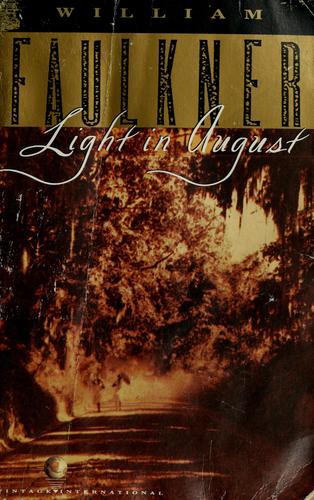
Talk to Light in August like its author wrote you back.
Get the ideas that fit your life — not generic summaries.
- Chat with the book
- Audiobook-style main ideas
- Adapts to your life and goals
- Helps you take action
What it argues
Light in August is one of Faulkner's greatest novels and, for many readers, a more accessible entry into his work than The Sound and the Fury. Published in 1932, it weaves together three separate narrative strands: Lena Grove, a young pregnant woman walking across Mississippi to find the father of her child, as placid and determined as a force of nature; Joe Christmas, a man of uncertain racial background who has spent his life in violent revolt against every human connection, and whose story drives the novel toward its brutal conclusion; and Reverend Gail Hightower, a disgraced minister trapped in a fantasy of Confederate glory, pulled back into the living world by what happens around him.
Joe Christmas is one of the most haunting figures in American fiction. His identity — is he Black or white? — is unknowable to him and to others, and the novel is an examination of what that uncertainty costs in a world organized entirely around the answer. He has been bounced through orphanages, rejected by both Black and white communities, taken in and expelled, violent and victimized. His relationship with Joanna Burden, a white abolitionist's daughter who first prays over him and then becomes his lover in a consuming, self-destructive obsession, is the novel's darkest strand.
What it gets right
- 1.
Joe Christmas's racial ambiguity is the novel's central engine: his suffering is not caused by being Black or white but by being uncategorizable in a world that requires the distinction.
- 2.
The three narrative strands — Lena's forward movement, Joe's trapped violence, Hightower's backward obsession — are different relationships to time and community, not just different plots.
- 3.
Joanna Burden's trajectory from initial resistance to sexual obsession to religious hysteria maps the novel's argument about what repressed racial guilt does to the white South.
What it covers
Who wrote it
William Faulkner (1897–1962) was an American novelist and short story writer from Mississippi, generally considered one of the most technically innovative writers in American literary history. He spent most of his life in Oxford, Mississippi, near which his fictional Yoknapatawpha County is set. His major works include The Sound and the Fury, As I Lay Dying, Absalom, Absalom!, and The Bear. He was awarded the Nobel Prize in Literature in 1949. Light in August, published in 1932, is often cited as a more accessible starting point for readers new to his work than his earlier, more formally radical novels.
