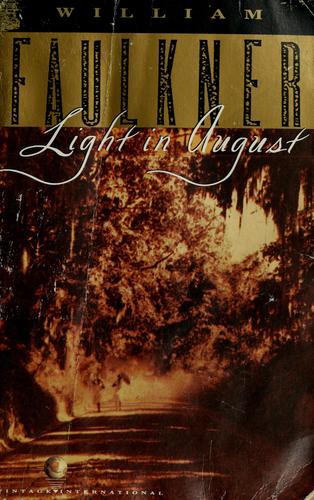
Light in August by William Faulkner is a 1932 literary fiction book about race and identity, isolation and community, fanaticism and violence. Joe Christmas's racial ambiguity is the novel's central engine: his suffering is not caused by being Black or white but by being uncategorizable in a world that requires the distinction.
Summary
Light in August is one of Faulkner's greatest novels and, for many readers, a more accessible entry into his work than The Sound and the Fury. Published in 1932, it weaves together three separate narrative strands: Lena Grove, a young pregnant woman walking across Mississippi to find the father of her child, as placid and determined as a force of nature; Joe Christmas, a man of uncertain racial background who has spent his life in violent revolt against every human connection, and whose story drives the novel toward its brutal conclusion; and Reverend Gail Hightower, a disgraced minister trapped in a fantasy of Confederate glory, pulled back into the living world by what happens around him.
Joe Christmas is one of the most haunting figures in American fiction. His identity — is he Black or white? — is unknowable to him and to others, and the novel is an examination of what that uncertainty costs in a world organized entirely around the answer. He has been bounced through orphanages, rejected by both Black and white communities, taken in and expelled, violent and victimized. His relationship with Joanna Burden, a white abolitionist's daughter who first prays over him and then becomes his lover in a consuming, self-destructive obsession, is the novel's darkest strand.
Faulkner moves between these three stories in large sections, each with its own tempo. Lena's chapters are almost pastoral; Joe's are intense and fragmented, moving back and forth in time; Hightower's are elegiac. The novel is long and requires patience, but it is Faulkner at his most structurally disciplined. The prose, while dense, is less experimental than The Sound and the Fury or As I Lay Dying — there is a third-person narrator here, and the time shifts are coherent rather than disorienting.
What makes the novel endure is the way it holds its three strands in suspension without forcing them to resolve neatly against each other. Lena's calm forward movement, Joe's trapped violence, and Hightower's backward obsession are three different relationships to time and fate, and the novel argues — quietly but insistently — that American violence around race is not an aberration but a structural feature. The title refers to the particular quality of August light in Mississippi; it gives the novel a strangely beautiful frame for what is, at its core, a dark reckoning with American history.
Talk to Light in August like its author wrote you back.
Get the ideas that fit your life — not generic summaries.
- Chat with the book
- Audiobook-style main ideas
- Adapts to your life and goals
- Helps you take action
Key takeaways
- 1.
Joe Christmas's racial ambiguity is the novel's central engine: his suffering is not caused by being Black or white but by being uncategorizable in a world that requires the distinction.
- 2.
The three narrative strands — Lena's forward movement, Joe's trapped violence, Hightower's backward obsession — are different relationships to time and community, not just different plots.
- 3.
Joanna Burden's trajectory from initial resistance to sexual obsession to religious hysteria maps the novel's argument about what repressed racial guilt does to the white South.
- 4.
Lena Grove is the novel's structural counterweight: while everyone else is destroyed by their relationship to the past, she simply moves forward toward her child. Her equanimity is not naivety — it is a different mode of being.
- 5.
Hightower's liberation from his Confederate fantasy arrives too late to save Joe, but it arrives. Faulkner is interested in the conditions under which the past can loosen its grip.
- 6.
The novel documents the religious violence of the American South — Calvinist certainty, fanaticism dressed as righteousness — as a continuous thread running from Joe's orphanage to his death.
- 7.
Percy Grimm, Joe's killer, is presented as a type — the empty young man who finds meaning in violence authorized by race — and Faulkner draws him with a clarity that reads as prophetic.
- 8.
The ending, with Lena still moving forward and Byron Bunch still following her, is the novel's only note of provisional hope — and it is deliberately small against the scale of what Joe's story has established.
Discussion questions
Use these on your own, with a book club, or as chat starters in Superbook. Book club version, ready to copy or print →
- 1.
Joe Christmas doesn't know whether he is Black or white. The novel suggests this unknowability is worse, in the South of this period, than certainty in either direction. Do you agree with that argument?
- 2.
Joanna Burden's religious condemnation and sexual obsession become entangled until she tries to kill Joe and he kills her. How does the novel frame this — as tragedy, as pathology, as social inevitability?
- 3.
Lena Grove is the first character we meet and arguably the most alien — her equanimity seems almost inhuman. Does she work as a character, or is she primarily a symbolic counterweight?
- 4.
Percy Grimm is presented as a type: the violent young man who finds meaning in enforcing racial order. Does he feel like a real character or a polemical sketch? Does it matter?
- 5.
Hightower is a man destroyed by his grandfather's Confederate past. What is Faulkner saying about the relationship between historical mythology and personal paralysis?
- 6.
The novel has three storylines that barely intersect. Does their separation feel like a formal achievement, or does it make the book feel like three novellas rather than one novel?
- 7.
Joe Christmas is one of the most isolated figures in American fiction — rejected by everyone, belonging nowhere. Is his violence explained or excused by his history? Does Faulkner want you to distinguish the two?
- 8.
Compare Percy Grimm to the forces that destroy characters in The Grapes of Wrath or Between the World and Me. How does institutionalized racial violence look different in Faulkner's close-focus rendering versus a more panoramic account?
- 9.
The title refers to light in August in Mississippi. How does the setting function in the novel — as atmosphere, as moral commentary, as something else?
- 10.
This novel was published in 1932. How does reading it in 2026 change what you notice? Does anything feel dated? Does anything feel more urgent than it did in Faulkner's own moment?
- 11.
Faulkner puts the Christmas story in the middle of the narrative, not at the beginning or end. What is the effect of encountering Lena first and last, with Joe's tragedy at the center?
- 12.
Between this novel, The Sound and the Fury, and As I Lay Dying, which Faulkner do you find most valuable — and for what reason?
Themes
Frequently asked questions
-
Is Light in August a good starting point for Faulkner?
Many Faulkner readers think so. It is complex but has a third-person narrator and coherent (if non-linear) time structure, which makes it more manageable than The Sound and the Fury. The three-strand structure takes time to cohere, but once it does the novel moves with real momentum.
-
Is it hard to read?
More accessible than The Sound and the Fury, but still demanding. Faulkner's sentences are long, the prose is dense, and the time shifts in Joe Christmas's sections require attention. Readers who are patient with non-linear structure will find it rewarding; readers who need straightforward narrative will find it work.
-
What is the novel actually about?
Most directly: a man of uncertain racial identity whose life is defined by his inability to belong anywhere in a world that requires racial categorization. More broadly: violence, religious fanaticism, gender, and what the South's obsession with its own past costs the living.
-
Who shouldn't read it?
Readers who want a single clear protagonist or a plot that resolves cleanly. The three narrative strands are held in productive tension rather than resolved against each other, and the novel ends on a note of quiet continuation rather than closure.
-
How does it compare to The Sound and the Fury?
Longer, more accessible, and more explicitly concerned with race. The Sound and the Fury is more formally radical (the Benjy section is harder than anything in Light in August) but more internal; Light in August is more outward-facing and political. Both are worth reading; start with whichever sounds less daunting.