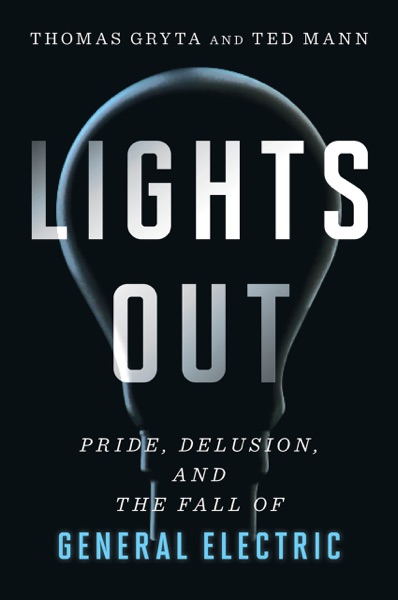
Talk to Lights Out like its author wrote you back.
Get the ideas that fit your life — not generic summaries.
- Chat with the book
- Audiobook-style main ideas
- Adapts to your life and goals
- Helps you take action
Lights Out, in detail
Lights Out chronicles the destruction of General Electric under Jeff Immelt, who took over from Jack Welch in September 2001 and left in 2017 having overseen one of the largest collapses of corporate value in American history. Thomas Gryta, who covered GE for the Wall Street Journal, and Ted Mann, a colleague, spent years reporting the story. The book is the most comprehensive account of how an institution once regarded as the gold standard of American management went from a company worth $600 billion to one that was removed from the Dow Jones Industrial Average.
The central argument is not that Immelt was incompetent — he was not — but that he inherited an organization built on financial engineering, accounting illusions, and a culture of performance pressure that made honest assessment nearly impossible. Jack Welch's GE Capital, which generated roughly half of the company's earnings in the late Welch years, was essentially a large and opaque financial institution attached to an industrial conglomerate. When the financial crisis hit in 2008, it nearly took the whole company down. Immelt spent the next decade trying to pivot GE back to its industrial roots while concealing, deliberately or otherwise, the depth of the structural problems he had inherited and created.
Gryta and Mann reconstruct the internal culture in detail: the quarterly earnings management that became a way of life, the board that was too deferential, the executives who told Immelt what he wanted to hear, the acquisitions that destroyed value, and the signature initiative — GE Digital — that Immelt believed would transform the company into a software platform and instead became a costly distraction. The power division problems, the insurance liabilities that had been buried for years, and the cash flow accounting that presented a rosier picture than the underlying business warranted all come into focus through reconstructed scenes and interviews.
The book is a case study in how institutional size and prestige can mask problems for years, how cultures of optimism and deference to authority create feedback loops that disconnect leadership from reality, and how a CEO's genuine belief in a narrative can be as dangerous as deliberate deception. It is also a useful corrective to the mythology of the Welch era: many of GE's problems under Immelt were incubated under Welch, who handed off a company whose financial complexity exceeded anyone's ability to manage.
The big ideas
- 1.
GE's decline was not primarily caused by Immelt's decisions but by structural problems — overleveraged financial operations, opaque accounting, and a culture of deference to authority — inherited from the Welch era.
- 2.
Earnings management, when practiced over decades, creates organizational habits that make honest assessment of the underlying business almost impossible to transmit upward.
- 3.
GE Capital was a hidden financial institution generating earnings that disguised the weakness of the industrial businesses; when financial engineering stops working, there is nothing underneath.
