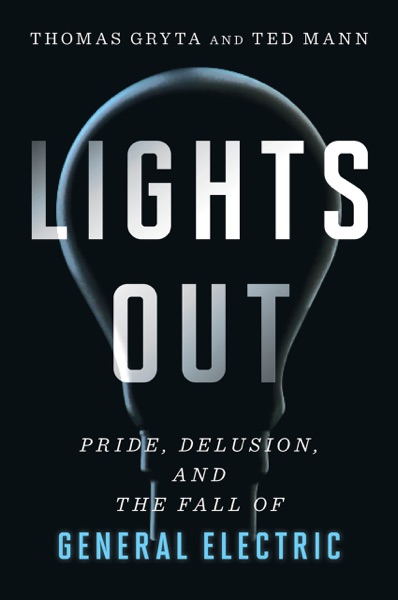
Lights Out by Thomas Gryta is a 2020 business book about corporate decline, leadership failure, accountability. GE's decline was not primarily caused by Immelt's decisions but by structural problems — overleveraged financial operations, opaque accounting, and a culture of deference to authority — inherited from the Welch era.
Summary
Lights Out chronicles the destruction of General Electric under Jeff Immelt, who took over from Jack Welch in September 2001 and left in 2017 having overseen one of the largest collapses of corporate value in American history. Thomas Gryta, who covered GE for the Wall Street Journal, and Ted Mann, a colleague, spent years reporting the story. The book is the most comprehensive account of how an institution once regarded as the gold standard of American management went from a company worth $600 billion to one that was removed from the Dow Jones Industrial Average.
The central argument is not that Immelt was incompetent — he was not — but that he inherited an organization built on financial engineering, accounting illusions, and a culture of performance pressure that made honest assessment nearly impossible. Jack Welch's GE Capital, which generated roughly half of the company's earnings in the late Welch years, was essentially a large and opaque financial institution attached to an industrial conglomerate. When the financial crisis hit in 2008, it nearly took the whole company down. Immelt spent the next decade trying to pivot GE back to its industrial roots while concealing, deliberately or otherwise, the depth of the structural problems he had inherited and created.
Gryta and Mann reconstruct the internal culture in detail: the quarterly earnings management that became a way of life, the board that was too deferential, the executives who told Immelt what he wanted to hear, the acquisitions that destroyed value, and the signature initiative — GE Digital — that Immelt believed would transform the company into a software platform and instead became a costly distraction. The power division problems, the insurance liabilities that had been buried for years, and the cash flow accounting that presented a rosier picture than the underlying business warranted all come into focus through reconstructed scenes and interviews.
The book is a case study in how institutional size and prestige can mask problems for years, how cultures of optimism and deference to authority create feedback loops that disconnect leadership from reality, and how a CEO's genuine belief in a narrative can be as dangerous as deliberate deception. It is also a useful corrective to the mythology of the Welch era: many of GE's problems under Immelt were incubated under Welch, who handed off a company whose financial complexity exceeded anyone's ability to manage.
Talk to Lights Out like its author wrote you back.
Get the ideas that fit your life — not generic summaries.
- Chat with the book
- Audiobook-style main ideas
- Adapts to your life and goals
- Helps you take action
Key takeaways
- 1.
GE's decline was not primarily caused by Immelt's decisions but by structural problems — overleveraged financial operations, opaque accounting, and a culture of deference to authority — inherited from the Welch era.
- 2.
Earnings management, when practiced over decades, creates organizational habits that make honest assessment of the underlying business almost impossible to transmit upward.
- 3.
GE Capital was a hidden financial institution generating earnings that disguised the weakness of the industrial businesses; when financial engineering stops working, there is nothing underneath.
- 4.
Boards that are too deferential to a powerful CEO are structurally unable to provide the accountability function they exist to provide.
- 5.
Large transformation initiatives like GE Digital are more likely to distract from core operational problems than to solve them, particularly when the core problems are not clearly named.
- 6.
A CEO's sincere belief in a narrative can be as harmful as dishonesty if it prevents accurate diagnosis; optimism and reality-avoidance are difficult to distinguish from the inside.
- 7.
The Welch legend was partly constructed on metrics — GE's stock performance and earnings growth — that reflected financial engineering more than industrial excellence.
- 8.
Institutional prestige creates dangerous complacency in analysts, journalists, investors, and board members, who all have incentives to believe the story they have been told.
Discussion questions
Use these on your own, with a book club, or as chat starters in Superbook. Book club version, ready to copy or print →
- 1.
The book argues that many of GE's problems were incubated under Jack Welch. How much responsibility does a CEO bear for problems that surface after they leave?
- 2.
Immelt received enormous positive press coverage for years while the company deteriorated. What does that say about financial journalism and the ability to assess large, complex institutions?
- 3.
The board was described as too deferential. What governance structures or board behaviors would have changed the outcome, and are they realistic?
- 4.
GE's culture of performance pressure made it dangerous to deliver bad news upward. Do you see that pattern in organizations you've worked in, and what sustains it?
- 5.
Gryta and Mann argue that Immelt genuinely believed the narratives he told investors. Does that make the failures better or worse from an ethical standpoint?
- 6.
GE Capital generated half the company's earnings in the Welch years. Was that level of dependence on a financial unit a structural mistake, or was it rational given the conditions of the time?
- 7.
The GE Digital initiative consumed billions and did not produce the expected transformation. What is the anatomy of a large transformational bet gone wrong?
- 8.
The insurance liabilities were buried for years in a way that required many people's cooperation or willful ignorance. How do institutional secrets of that scale persist?
- 9.
The company survived but was fundamentally restructured, shedding most of its businesses. Is breaking up a conglomerate this large ever the right answer before a crisis forces it?
- 10.
The Welch era was widely studied and admired; Immelt's era is widely studied as a cautionary tale. Is the difference mainly results, or is there a genuine difference in how they managed?
- 11.
Lights Out is a journalist's reconstruction from interviews and documents. What can this kind of narrative history tell you that financial analysis can't, and vice versa?
- 12.
If you were advising the GE board in 2012 — halfway through the deterioration — what would you have needed to see to understand how serious the situation was?
Themes
Frequently asked questions
-
Is Lights Out just about Jeff Immelt, or does it cover the Welch era too?
It covers both, though Immelt's tenure is the primary focus. Gryta and Mann make a sustained argument that the structural problems that destroyed value under Immelt — the over-reliance on GE Capital, the accounting complexity, the culture of earnings management — were established or intensified under Welch. The book is as much a critique of the Welch legend as it is an account of Immelt's leadership.
-
How long does it take to read Lights Out?
Around five to six hours for the 300-page book. The narrative is chronological and fast-moving; the financial chapters are somewhat denser but the authors explain the mechanics without requiring deep accounting knowledge.
-
Is this relevant to anyone outside business and finance?
Yes. The book is really about institutional culture, accountability failures, and the gap between public narrative and internal reality. Those dynamics appear in government agencies, nonprofits, and universities as much as in corporations.
-
Was Immelt dishonest or just mistaken?
The book is careful not to make that call definitively. There are documented cases of financial presentation that misled investors. There are also reconstructed scenes in which Immelt appears to genuinely believe the narrative he is telling. The line between optimism, self-deception, and deliberate misleading is one the authors explore without fully resolving.
-
What's the biggest lesson from GE's collapse?
That earnings growth and stock performance can mask structural problems for years, and that the culture of an organization can become its biggest liability when that culture makes honest diagnosis unsafe. The board's deference to leadership is a close second.
Similar books

Bad Blood: Secrets and Lies in a Silicon Valley Startup
John Carreyrou
The Big Short: Inside the Doomsday Machine
Michael Lewis
Super Pumped: The Battle for Uber
Mike Isaac
Empire of Pain: The Secret History of the Sackler Dynasty
Patrick Radden Keefe
