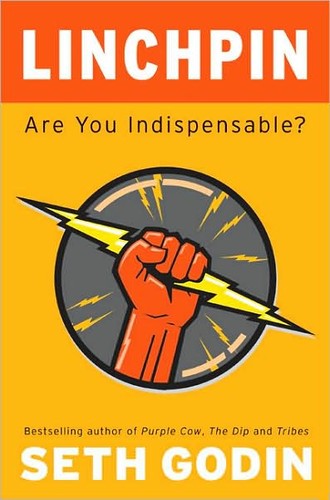
Talk to Linchpin: Are You Indispensable? like its author wrote you back.
Get the ideas that fit your life — not generic summaries.
- Chat with the book
- Audiobook-style main ideas
- Adapts to your life and goals
- Helps you take action
Linchpin: Are You Indispensable?, in detail
Linchpin is Seth Godin's argument that the industrial economy's model of interchangeable workers following instructions is collapsing, and that the people who thrive in what comes next will be those who do work that can't be systemized or outsourced — people who make decisions, solve problems without a manual, and bring genuine humanity and creativity to their work. Godin calls these people linchpins. The opposite of a linchpin is a cog: someone who does their job adequately, follows the rules, and can be replaced without much disruption.
The book's central psychological concept is "the lizard brain," Godin's term for the voice that tells you not to ship the project, not to raise your hand, not to make the art because it might be criticized. He argues that the industrial system was built on the assumption that workers should suppress creativity in favor of compliance, and that this training runs so deep that most people now apply it even when it's no longer necessary. The lizard brain, for Godin, is the internal enforcer of a system that no longer serves most people's interests.
Godin's prescription is to create "art" in a broad sense — work that carries the maker's personal perspective and genuine engagement, delivered as a gift rather than as an obligation. The gift frame is important: he argues that linchpins don't do extra work because they're paid to but because they've internalized a different model of professional life, one where giving without explicit transaction is the behavior that builds reputation and leverage over time.
The book is more philosophical than tactical. Godin doesn't give you a step-by-step system for becoming indispensable; he gives you a set of reframes about what work is for, what the resistance you feel is, and why safety through compliance is no longer as safe as it feels. The writing has the aphoristic quality of most Godin books — punchy, quotable, occasionally repetitive — and the argument circles back to its core points more than once. Readers looking for specific career frameworks will find this unsatisfying. Readers open to an examination of how they think about their own work will find it provocative.
The big ideas
- 1.
The industrial economy rewarded compliance and predictability. The connection economy rewards creativity, judgment, and emotional labor.
- 2.
The lizard brain — Godin's term for fear and the instinct toward safety — is the primary reason people don't do the work they're capable of. Naming it is the first step to working around it.
- 3.
Linchpins treat their work as art: something that carries their unique perspective and is given as a gift rather than traded as a transaction.
