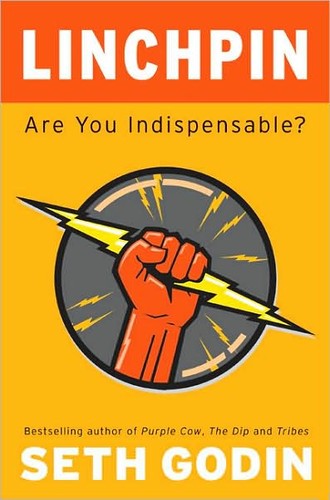
Linchpin: Are You Indispensable? by Seth Godin is a 2010 business book about work, creativity, indispensability. The industrial economy rewarded compliance and predictability. The connection economy rewards creativity, judgment, and emotional labor.
Summary
Linchpin is Seth Godin's argument that the industrial economy's model of interchangeable workers following instructions is collapsing, and that the people who thrive in what comes next will be those who do work that can't be systemized or outsourced — people who make decisions, solve problems without a manual, and bring genuine humanity and creativity to their work. Godin calls these people linchpins. The opposite of a linchpin is a cog: someone who does their job adequately, follows the rules, and can be replaced without much disruption.
The book's central psychological concept is "the lizard brain," Godin's term for the voice that tells you not to ship the project, not to raise your hand, not to make the art because it might be criticized. He argues that the industrial system was built on the assumption that workers should suppress creativity in favor of compliance, and that this training runs so deep that most people now apply it even when it's no longer necessary. The lizard brain, for Godin, is the internal enforcer of a system that no longer serves most people's interests.
Godin's prescription is to create "art" in a broad sense — work that carries the maker's personal perspective and genuine engagement, delivered as a gift rather than as an obligation. The gift frame is important: he argues that linchpins don't do extra work because they're paid to but because they've internalized a different model of professional life, one where giving without explicit transaction is the behavior that builds reputation and leverage over time.
The book is more philosophical than tactical. Godin doesn't give you a step-by-step system for becoming indispensable; he gives you a set of reframes about what work is for, what the resistance you feel is, and why safety through compliance is no longer as safe as it feels. The writing has the aphoristic quality of most Godin books — punchy, quotable, occasionally repetitive — and the argument circles back to its core points more than once. Readers looking for specific career frameworks will find this unsatisfying. Readers open to an examination of how they think about their own work will find it provocative.
Talk to Linchpin: Are You Indispensable? like its author wrote you back.
Get the ideas that fit your life — not generic summaries.
- Chat with the book
- Audiobook-style main ideas
- Adapts to your life and goals
- Helps you take action
Key takeaways
- 1.
The industrial economy rewarded compliance and predictability. The connection economy rewards creativity, judgment, and emotional labor.
- 2.
The lizard brain — Godin's term for fear and the instinct toward safety — is the primary reason people don't do the work they're capable of. Naming it is the first step to working around it.
- 3.
Linchpins treat their work as art: something that carries their unique perspective and is given as a gift rather than traded as a transaction.
- 4.
Shipping matters more than perfection. The resistance will always find a reason to delay; the linchpin ships and then improves.
- 5.
Being indispensable is not about working more hours. It's about bringing judgment, emotional intelligence, and genuine engagement to work that others do only mechanically.
- 6.
Gift-giving in work — doing more than is required, connecting people who should meet, solving problems before they're asked — builds long-term leverage that salary negotiation cannot.
- 7.
Most people are not held back by lack of skill or opportunity but by the internal prohibition against standing out, which the industrial system installed and which most people never question.
- 8.
Maps are for people who follow instructions. Linchpins draw maps — they navigate without a guide because the novel situations they face don't have one.
Discussion questions
Use these on your own, with a book club, or as chat starters in Superbook. Book club version, ready to copy or print →
- 1.
Godin distinguishes linchpins from cogs. Which role do you occupy in your current work, and how much of that is chosen versus structural?
- 2.
What does your lizard brain tell you when you're about to do something that might be criticized? What specific project or conversation has it talked you out of recently?
- 3.
The book argues that safety through compliance is less safe than it feels. Do you find that convincing, given the actual risks in your field or organization?
- 4.
Godin says the gift frame — doing more without an explicit transaction — builds long-term leverage. Can you name someone in your professional life who operates this way, and what effect does it have?
- 5.
What would it mean for your current work to be 'art' in Godin's sense? What would you have to change about how you approach it?
- 6.
The book is light on tactical advice. Does that frustrate you, or do you find the philosophical reframe more useful than a framework would be?
- 7.
Godin argues that shipping — getting the work out — is more important than perfecting it. Where in your work do you use perfectionism as a form of resistance?
- 8.
What is the most indispensable thing you do at work? If you left your organization tomorrow, what would be hardest to replace?
- 9.
The industrial model trained people to follow instructions without adding judgment. Where in your current work are you following instructions that no longer need to be followed?
- 10.
Godin says linchpins are made, not born. Which experiences in your life have moved you toward or away from this way of working?
- 11.
The concept of emotional labor — caring about the experience of the person in front of you regardless of mood or incentive — is central to the book. Where in your work do you do this, and where do you withhold it?
- 12.
If you knew you couldn't fail and couldn't be fired, what would you do differently in your work starting tomorrow?
Themes
Frequently asked questions
-
Is Linchpin worth reading?
Yes, if you're open to a philosophical argument about work rather than a tactical guide. Godin's writing is punchy and the core idea — that compliance is not safety — is worth sitting with. If you want a step-by-step career framework, look elsewhere.
-
What is the main argument of Linchpin?
That the industrial economy's model of interchangeable, instruction-following workers is ending, and the people who thrive in the new economy will be those who bring creativity, judgment, and genuine humanity to work that can't be systematized.
-
What is the lizard brain?
Godin's term for the ancient, fear-driven part of the brain that discourages risk and favors safety. In work terms, it's the voice that says 'don't raise your hand,' 'don't ship this,' 'don't stand out.' Godin argues that recognizing it is the beginning of working past it.
-
How does Linchpin compare to other Seth Godin books?
It's longer and more personal than most Godin books and makes a broader argument than category-specific works like Purple Cow or Permission Marketing. The style is consistent — aphoristic, punchy, occasionally repetitive — but the ambition is larger.
-
Who shouldn't read Linchpin?
Readers who want tactical career advice, specific frameworks, or evidence-based research will find the book unsatisfying. Godin writes in assertions and metaphors, not studies. If you found his other books too abstract, this one is similar.