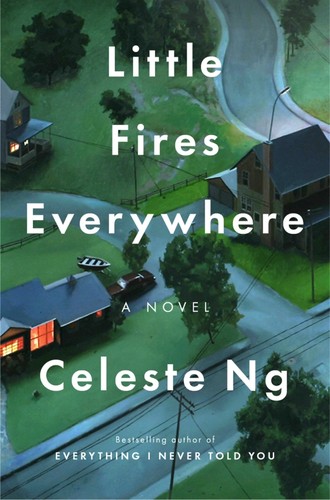
Talk to Little Fires Everywhere like its author wrote you back.
Get the ideas that fit your life — not generic summaries.
- Chat with the book
- Audiobook-style main ideas
- Adapts to your life and goals
- Helps you take action
Little Fires Everywhere, in detail
In Shaker Heights, Ohio — a meticulously planned, deliberately integrated suburb — two families collide. The Richardsons are everything Shaker Heights was designed to produce: stable, affluent, civic-minded, white. Elena Richardson follows the rules because she believes in them. Mia Warren is a nomadic artist who arrives with her teenage daughter Pearl and rents from the Richardsons. She doesn't follow rules because she's never had the luxury of believing they apply equally. When a custody dispute over a Chinese-American baby splits the community along its hidden fault lines, both women's pasts and principles are drawn into conflict.
The novel is fundamentally about the difference between following the rules and doing the right thing — and about who gets to decide which is which. Ng is particularly sharp on how privilege disguises itself as principle. Elena Richardson doesn't think of herself as someone who uses her position to get what she wants; she thinks of herself as someone who works hard and does things correctly. The novel is interested in the gap between those two self-understandings. Mia, for her part, isn't an uncomplicated heroine; her choices have costs that fall on Pearl, and the book doesn't let her off the hook for them.
Ng's prose is clear and controlled, moving between multiple perspectives with clean craft. The plotting is novelistic in the best sense: it earns its revelations, and the secrets that surface feel logical in retrospect rather than contrived. The Hulu adaptation (2020, starring Reese Witherspoon and Kerry Washington) amplified several themes around race that the novel handles with more subtlety and ambiguity. The book is better than the show, which is the correct relationship.
This is a strong book-club novel: almost everyone will have a different character they want to defend or convict, which generates good conversation. It wears its themes visibly — that's a feature for groups, a minor flaw for readers who prefer subtext. The comparison points are Anne Tyler's domestic novels and Jodi Picoult's moral dilemmas, but Ng is more formally careful than either.
The big ideas
- 1.
Privilege tends to look like principle from the inside. Elena Richardson's certainty that she's simply following the rules is the novel's central irony.
- 2.
Motherhood is examined from almost every angle — biological, adoptive, chosen, abandoned — and the novel refuses to rank them.
- 3.
The custody plot forces readers to hold competing goods simultaneously: what's culturally right versus what's materially best for a child.
