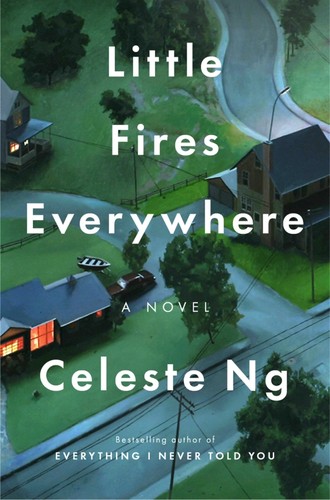
Little Fires Everywhere by Celeste Ng is a 2017 contemporary fiction book about race and privilege, motherhood, identity and belonging. Privilege tends to look like principle from the inside. Elena Richardson's certainty that she's simply following the rules is the novel's central irony.
Summary
In Shaker Heights, Ohio — a meticulously planned, deliberately integrated suburb — two families collide. The Richardsons are everything Shaker Heights was designed to produce: stable, affluent, civic-minded, white. Elena Richardson follows the rules because she believes in them. Mia Warren is a nomadic artist who arrives with her teenage daughter Pearl and rents from the Richardsons. She doesn't follow rules because she's never had the luxury of believing they apply equally. When a custody dispute over a Chinese-American baby splits the community along its hidden fault lines, both women's pasts and principles are drawn into conflict.
The novel is fundamentally about the difference between following the rules and doing the right thing — and about who gets to decide which is which. Ng is particularly sharp on how privilege disguises itself as principle. Elena Richardson doesn't think of herself as someone who uses her position to get what she wants; she thinks of herself as someone who works hard and does things correctly. The novel is interested in the gap between those two self-understandings. Mia, for her part, isn't an uncomplicated heroine; her choices have costs that fall on Pearl, and the book doesn't let her off the hook for them.
Ng's prose is clear and controlled, moving between multiple perspectives with clean craft. The plotting is novelistic in the best sense: it earns its revelations, and the secrets that surface feel logical in retrospect rather than contrived. The Hulu adaptation (2020, starring Reese Witherspoon and Kerry Washington) amplified several themes around race that the novel handles with more subtlety and ambiguity. The book is better than the show, which is the correct relationship.
This is a strong book-club novel: almost everyone will have a different character they want to defend or convict, which generates good conversation. It wears its themes visibly — that's a feature for groups, a minor flaw for readers who prefer subtext. The comparison points are Anne Tyler's domestic novels and Jodi Picoult's moral dilemmas, but Ng is more formally careful than either.
Talk to Little Fires Everywhere like its author wrote you back.
Get the ideas that fit your life — not generic summaries.
- Chat with the book
- Audiobook-style main ideas
- Adapts to your life and goals
- Helps you take action
Key takeaways
- 1.
Privilege tends to look like principle from the inside. Elena Richardson's certainty that she's simply following the rules is the novel's central irony.
- 2.
Motherhood is examined from almost every angle — biological, adoptive, chosen, abandoned — and the novel refuses to rank them.
- 3.
The custody plot forces readers to hold competing goods simultaneously: what's culturally right versus what's materially best for a child.
- 4.
Shaker Heights is a real place, and Ng uses its planned-community utopian history to ground the novel's argument about what design can and cannot fix in human nature.
- 5.
The teenagers — especially Izzy and Pearl — carry the emotional weight of the novel because they haven't yet learned to protect themselves from other people's myths about who they are.
- 6.
Mia's art-making is described with enough specificity to feel real, and her aesthetic is a counterpoint to Elena's worldview: Mia makes things that are meant to disturb, not to fit.
- 7.
The fire at the end is set deliberately, but the novel's point is that the conditions for it were set years before — 'little fires' that no one chose to put out.
- 8.
Race operates in the novel not as a blunt force but as a set of assumptions characters can't see until an outsider makes them visible.
Discussion questions
Use these on your own, with a book club, or as chat starters in Superbook. Book club version, ready to copy or print →
- 1.
Elena Richardson believes she has followed the rules her whole life and that following rules is inherently moral. Is the novel arguing she's wrong, or that she's missing something?
- 2.
The custody case — should Mirabelle go back to her Chinese birth mother or stay with the McCullochs who raised her? What does the novel seem to think, and do you agree?
- 3.
Mia makes deliberate choices that cost Pearl stability and community. How much does the novel hold her accountable for those costs?
- 4.
Izzy and Pearl are drawn to each other's families in ways that complicate simple class envy. What are each of them actually looking for?
- 5.
Shaker Heights was designed to be a model integrated community. How does Ng use the suburb's history against its residents' self-image?
- 6.
Elena eventually discovers Mia's past. Does that discovery change how you read Mia's choices, or does it feel like a cheap explanation?
- 7.
The novel has several mothers — Elena, Mia, Linda McCullough, Bebe Chow — none of whom are simply good or simply bad. Which one do you find most sympathetic, and why?
- 8.
Ng wrote a Chinese-American custody dispute with obvious attention to racial dynamics. Does the novel handle those dynamics with sufficient complexity, or does it simplify?
- 9.
The Hulu adaptation made explicit things the novel keeps ambiguous. If you've seen it, which version's choices do you prefer?
- 10.
The title refers to literal fires as well as metaphorical ones. What 'little fires' in the Richardsons' family life should have been addressed earlier?
- 11.
Pearl is caught between loyalty to her mother and attraction to everything the Richardsons represent. Is her story arc satisfying?
- 12.
Elena asks late in the novel whether Mia has ever followed the rules. What would it mean, in this novel's terms, to follow a rule that shouldn't exist?
Themes
Frequently asked questions
-
Is Little Fires Everywhere a good book club pick?
Very good. It's designed to generate disagreement — almost every reader comes away with a different character they want to defend or condemn. The custody subplot alone produces hours of argument. The themes (race, class, motherhood, privilege) are substantial without requiring specialist knowledge.
-
How does the Hulu series compare to the book?
The show amplifies racial themes that the novel treats with more ambiguity, particularly in Elena's character. Kerry Washington and Reese Witherspoon are excellent, but the adaptation sharpens moral edges the book deliberately leaves blurry. If you've seen the show, the book will feel quieter and more nuanced.
-
What is the 'little fires' of the title?
Literally, the fires set at the Richardson house at the end of the novel. Metaphorically, the novel argues that the family's collapse was built from small failures to address the truth of their situation — fires that were little only because they'd been ignored for so long.
-
Who shouldn't read this book?
Readers who prefer plot over character study, or who find domestic drama claustrophobic. The novel is slow in places by design — it's interested in interior states and social architecture more than event velocity. Also, the ending is deliberately unresolved, which frustrates some readers.
-
Is this related to Everything I Never Told You?
Same author, different story, same thematic territory (race, family secrets, what parents pass on to children). The two novels stand alone but reward being read together.