Talk to Loonshots like its author wrote you back.
Get the ideas that fit your life — not generic summaries.
- Chat with the book
- Audiobook-style main ideas
- Adapts to your life and goals
- Helps you take action
Loonshots, in detail
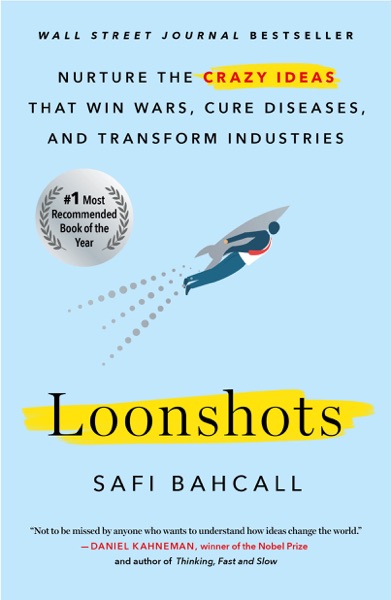
Loonshots is physicist and biotech CEO Safi Bahcall's argument that the most transformative innovations — the kind he calls loonshots, after the eccentric northern bird — are fragile ideas that look foolish or impossible until they suddenly aren't, and that organizations systematically kill them long before they get a chance to prove themselves. The question the book tries to answer is: why do some companies and institutions sustain innovation over decades while others, often right at the moment of their greatest success, stop producing it?
Bahcall's central tool is a physics analogy. When water reaches a critical temperature, it undergoes a phase transition and becomes ice. He argues that organizations undergo a similar phase transition as they grow: below a certain size, they behave like nimble groups of artists and experimenters; above it, they become political machines where career incentives dominate and no one champions high-risk ideas anymore. The key variable is not the leader's personality but the structure — the ratio of equity stakes to salaries, the span of management, the feedback loops that determine whether nurturing a crazy idea is personally rewarding or career-damaging.
The historical case studies are the book's real strength. Bahcall traces how radar and sulfa drugs transformed World War II, how Pan Am missed the jet age despite dominating aviation, and how Bell Labs sustained radical invention for decades. The case studies are not just illustrative — he uses them to test his structural claims. The pattern that emerges is that the best innovative organizations maintained a separation between the loonshot nursery (where crazy ideas were protected) and the franchise (the core business), and had leaders who could serve as what Bahcall calls the Bush-Vail transfer, shuttling insights between the two without contaminating either.
The book is more rigorous than most business books, which is both its strength and its occasional liability. Bahcall's physics background makes him genuinely careful about causation; he also sometimes over-extends the analogy. The practical prescriptions in the final chapters are less distinctive than the framework that precedes them. But the core insight — that the death of innovation in large organizations is a structural problem with a structural solution, not a cultural one — is worth the read.
The big ideas
- 1.
Loonshots — fragile, seemingly foolish ideas — are what drive transformative change, but organizations are structurally disposed to kill them before they mature.
- 2.
Organizations undergo a phase transition as they grow: below a certain structural threshold they nurture innovation; above it, career politics crowd out radical ideas.
- 3.
The key structural variable is not leadership personality but the balance between equity-based and salary-based incentives — who gains from championing a risky idea vs. protecting existing franchises.
