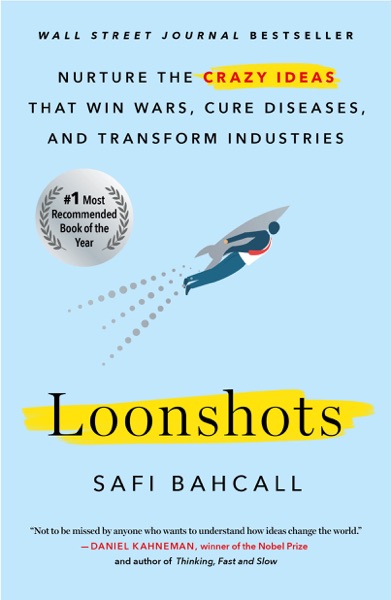
Loonshots by Safi Bahcall is a 2019 business book about innovation, organizational behavior, strategy. Loonshots — fragile, seemingly foolish ideas — are what drive transformative change, but organizations are structurally disposed to kill them before they mature.
Summary
Loonshots is physicist and biotech CEO Safi Bahcall's argument that the most transformative innovations — the kind he calls loonshots, after the eccentric northern bird — are fragile ideas that look foolish or impossible until they suddenly aren't, and that organizations systematically kill them long before they get a chance to prove themselves. The question the book tries to answer is: why do some companies and institutions sustain innovation over decades while others, often right at the moment of their greatest success, stop producing it?
Bahcall's central tool is a physics analogy. When water reaches a critical temperature, it undergoes a phase transition and becomes ice. He argues that organizations undergo a similar phase transition as they grow: below a certain size, they behave like nimble groups of artists and experimenters; above it, they become political machines where career incentives dominate and no one champions high-risk ideas anymore. The key variable is not the leader's personality but the structure — the ratio of equity stakes to salaries, the span of management, the feedback loops that determine whether nurturing a crazy idea is personally rewarding or career-damaging.
The historical case studies are the book's real strength. Bahcall traces how radar and sulfa drugs transformed World War II, how Pan Am missed the jet age despite dominating aviation, and how Bell Labs sustained radical invention for decades. The case studies are not just illustrative — he uses them to test his structural claims. The pattern that emerges is that the best innovative organizations maintained a separation between the loonshot nursery (where crazy ideas were protected) and the franchise (the core business), and had leaders who could serve as what Bahcall calls the Bush-Vail transfer, shuttling insights between the two without contaminating either.
The book is more rigorous than most business books, which is both its strength and its occasional liability. Bahcall's physics background makes him genuinely careful about causation; he also sometimes over-extends the analogy. The practical prescriptions in the final chapters are less distinctive than the framework that precedes them. But the core insight — that the death of innovation in large organizations is a structural problem with a structural solution, not a cultural one — is worth the read.
Talk to Loonshots like its author wrote you back.
Get the ideas that fit your life — not generic summaries.
- Chat with the book
- Audiobook-style main ideas
- Adapts to your life and goals
- Helps you take action
Key takeaways
- 1.
Loonshots — fragile, seemingly foolish ideas — are what drive transformative change, but organizations are structurally disposed to kill them before they mature.
- 2.
Organizations undergo a phase transition as they grow: below a certain structural threshold they nurture innovation; above it, career politics crowd out radical ideas.
- 3.
The key structural variable is not leadership personality but the balance between equity-based and salary-based incentives — who gains from championing a risky idea vs. protecting existing franchises.
- 4.
The best innovative organizations separate the loonshot nursery from the franchise operation, protecting both from contaminating each other.
- 5.
Leaders of innovative organizations act as a 'Bush-Vail transfer' — shuttling insights between experimenters and operators without forcing premature scaling or killing unconventional ideas through franchise logic.
- 6.
Failure analysis is as important as success analysis: studying why Pan Am missed the jet age or why the US Army almost rejected radar reveals patterns that success stories obscure.
- 7.
A good loonshot can look indistinguishable from a bad one before the right conditions exist to test it; the organization's job is to run more experiments, not to predict winners.
- 8.
The phase transition happens at roughly 150 people for most organizations, though equity structure can shift the threshold significantly in either direction.
Discussion questions
Use these on your own, with a book club, or as chat starters in Superbook. Book club version, ready to copy or print →
- 1.
Bahcall argues that the death of innovation is structural, not cultural. Does that match your experience of organizations you've worked in?
- 2.
His phase-transition analogy draws directly from physics. Does the scientific framing make the argument more convincing or does it give a false air of precision to organizational claims?
- 3.
The Bush-Vail transfer — the leader who bridges loonshot and franchise — is described as essential. Who in your organization plays that role, and what would happen if they left?
- 4.
Pan Am dominated aviation and still missed the jet age. What is the equivalent risk in a dominant organization you know well today?
- 5.
Bahcall says most loonshots look identical to bad ideas at the outset. How do you decide which fragile ideas deserve protection in your own work?
- 6.
Bell Labs sustained radical innovation for decades by separating basic research from product development. Could that model work in a startup or a mid-sized company?
- 7.
He argues that equity structure is more important than culture in determining innovation output. Do you agree? What evidence would change your mind?
- 8.
The book distinguishes between P-type loonshots (new products or technologies) and S-type loonshots (new strategies or business models). Which type is harder to protect, in your experience?
- 9.
Bahcall treats radical failure as valuable data. What failed loonshot in your field, in retrospect, carried information that was ignored?
- 10.
The 150-person phase transition threshold suggests that size itself is an innovation killer. Is staying small deliberately a viable strategy, or is growth always worth the tradeoff?
- 11.
The book is heavy with wartime examples — radar, sulfa drugs, the Manhattan Project. Does the military framing import assumptions that don't transfer well to commercial innovation?
- 12.
Bahcall ends with specific structural prescriptions. Which one would you most want to implement, and what organizational resistance would you expect?
Themes
Frequently asked questions
-
Is Loonshots worth reading for non-scientists?
Yes. The physics analogy is explained clearly and the historical case studies carry the argument independently. Readers without a science background will lose nothing essential. Those with one will enjoy the precision with which Bahcall applies physics concepts to organizational dynamics.
-
How long does it take to read Loonshots?
Around five to six hours for the full 352 pages. The historical chapters on radar and sulfa drugs are the most engrossing sections; the structural prescriptions in the final chapters can be read more quickly.
-
What is a loonshot exactly?
Bahcall defines it as a neglected project or unconventional idea that is widely dismissed as crazy but that, if it succeeds, can change entire industries or fields. The name comes from the loon bird, which appears ungainly and awkward on land but is built for the water.
-
How is Loonshots different from The Innovator's Dilemma?
Christensen focuses on how incumbents are disrupted by new entrants with different technology; Bahcall focuses on why innovative organizations stop producing breakthroughs at all, regardless of external competition. The unit of analysis is the organization's internal structure, not the competitive landscape.
-
Who should read this book?
Leaders of organizations navigating the transition from small and nimble to large and complex, product managers trying to protect unconventional ideas, and anyone who has watched a company lose its creative edge and wondered why it happened.