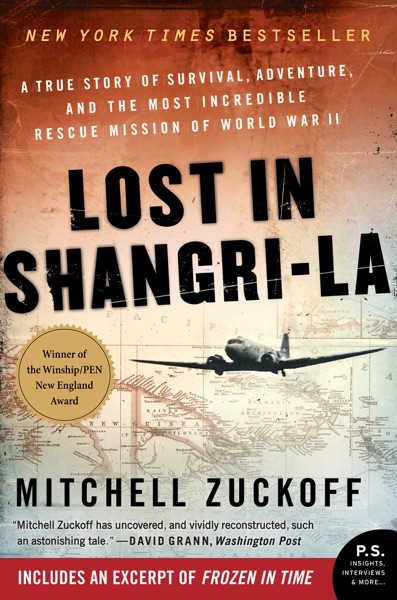
Talk to Lost in Shangri-La like its author wrote you back.
Get the ideas that fit your life — not generic summaries.
- Chat with the book
- Audiobook-style main ideas
- Adapts to your life and goals
- Helps you take action
Lost in Shangri-La, in detail
Lost in Shangri-La tells the story of a 1945 military plane crash in the Baliem Valley of New Guinea — a hidden highland region so remote and unknown to the outside world that the press called it Shangri-La. Twenty-four people were on the sightseeing flight; twenty-one died in the crash or fire that followed. The three survivors — two men and one woman, WAC Corporal Margaret Hastings — were alive in a valley that had never had contact with the Western world, surrounded by indigenous Dani tribespeople who had never seen white people or aircraft.
Mitchell Zuckoff reconstructs the story from military records, survivor accounts, and interviews with Dani elders and their descendants. The narrative moves between three threads: the survivors' ordeal on the ground, the rescue planning and preparation at the army base, and the experiences of the Dani community encountering outsiders for the first time. That third thread is handled with genuine care and keeps the book from becoming a simple adventure story.
The rescue operation itself was extraordinary. The valley's terrain made conventional landing impossible, so the Army Air Forces experimented with dropping paratroopers and using a glider extraction that had never been attempted in the field. The logistics — getting supplies in, getting survivors out — were solved through improvisation under pressure.
Zuckoff writes with the pacing of a thriller and the research discipline of a journalist. The book doesn't overreach: it tells this particular story rather than trying to make it a meditation on colonialism or indigenous contact, though those themes are present and handled honestly. As military history and adventure narrative, it works exceptionally well. As a study in crisis response, improvisation, and human adaptability under extreme conditions, it also offers more than a good yarn.
The big ideas
- 1.
The Baliem Valley in 1945 was home to the Dani people, who had had no contact with the outside world and whose society was fully functioning and complex — the 'primitive' framing in contemporaneous press coverage was a projection, not a description.
- 2.
Survivor psychology in extreme conditions often depends on small acts of mutual aid and determined normality — Hastings, Decker, and McCollom kept each other going through daily routines and divided responsibilities.
- 3.
The Army's rescue operation required inventing techniques in real time: the glider extraction method used to evacuate the survivors had not been field-tested in the conditions they faced.
