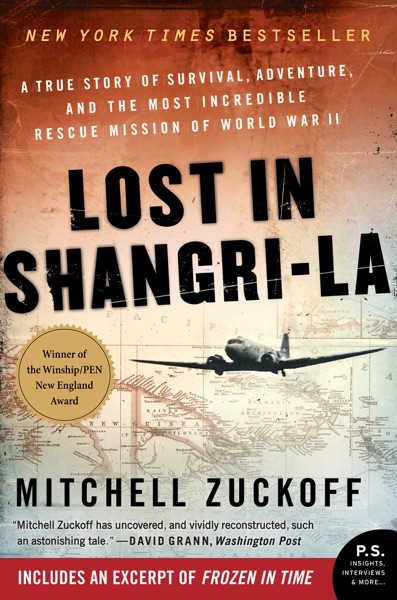
Lost in Shangri-La by Mitchell Zuckoff is a 2011 history book about survival, world war ii, adventure. The Baliem Valley in 1945 was home to the Dani people, who had had no contact with the outside world and whose society was fully functioning and complex — the 'primitive' framing in contemporaneous press coverage was a projection, not a description.
Summary
Lost in Shangri-La tells the story of a 1945 military plane crash in the Baliem Valley of New Guinea — a hidden highland region so remote and unknown to the outside world that the press called it Shangri-La. Twenty-four people were on the sightseeing flight; twenty-one died in the crash or fire that followed. The three survivors — two men and one woman, WAC Corporal Margaret Hastings — were alive in a valley that had never had contact with the Western world, surrounded by indigenous Dani tribespeople who had never seen white people or aircraft.
Mitchell Zuckoff reconstructs the story from military records, survivor accounts, and interviews with Dani elders and their descendants. The narrative moves between three threads: the survivors' ordeal on the ground, the rescue planning and preparation at the army base, and the experiences of the Dani community encountering outsiders for the first time. That third thread is handled with genuine care and keeps the book from becoming a simple adventure story.
The rescue operation itself was extraordinary. The valley's terrain made conventional landing impossible, so the Army Air Forces experimented with dropping paratroopers and using a glider extraction that had never been attempted in the field. The logistics — getting supplies in, getting survivors out — were solved through improvisation under pressure.
Zuckoff writes with the pacing of a thriller and the research discipline of a journalist. The book doesn't overreach: it tells this particular story rather than trying to make it a meditation on colonialism or indigenous contact, though those themes are present and handled honestly. As military history and adventure narrative, it works exceptionally well. As a study in crisis response, improvisation, and human adaptability under extreme conditions, it also offers more than a good yarn.
Talk to Lost in Shangri-La like its author wrote you back.
Get the ideas that fit your life — not generic summaries.
- Chat with the book
- Audiobook-style main ideas
- Adapts to your life and goals
- Helps you take action
Key takeaways
- 1.
The Baliem Valley in 1945 was home to the Dani people, who had had no contact with the outside world and whose society was fully functioning and complex — the 'primitive' framing in contemporaneous press coverage was a projection, not a description.
- 2.
Survivor psychology in extreme conditions often depends on small acts of mutual aid and determined normality — Hastings, Decker, and McCollom kept each other going through daily routines and divided responsibilities.
- 3.
The Army's rescue operation required inventing techniques in real time: the glider extraction method used to evacuate the survivors had not been field-tested in the conditions they faced.
- 4.
Indigenous communities encountering outsiders for the first time bring their own frameworks and purposes to those encounters, which are not the same as the frameworks the outsiders bring.
- 5.
Military sightseeing flights over active war zones — the kind of institutional casualness that allowed twenty-four people to be in the wrong place — reflect how far the war had moved from the Pacific front by 1945.
- 6.
Margaret Hastings's account challenges the period's assumptions about women in military service. Her survival, leadership, and composure were as significant as either man's.
- 7.
Improvised logistics under extreme constraints often produce better solutions than planned ones would have, because necessity forces creativity that peacetime planning committees avoid.
- 8.
The Dani community's subsequent history — exposure to disease, missionary contact, and eventually Indonesian rule — is a reminder that first contact is rarely a neutral or benign event for the contacted.
Discussion questions
Use these on your own, with a book club, or as chat starters in Superbook. Book club version, ready to copy or print →
- 1.
How does Zuckoff handle the Dani perspective in a book where the primary documentation comes from American sources?
- 2.
What does Margaret Hastings's experience reveal about gender and military service in World War II, and how does her account complicate simple narratives about women in the war?
- 3.
The rescue required improvising techniques that had never been tried in the field. What enabled that improvisation, and what conditions usually prevent organizations from operating that way?
- 4.
The press called the Baliem Valley 'Shangri-La.' What does that framing reveal about American assumptions in 1945, and what would be different about how media would cover a similar story today?
- 5.
The Dani had a fully developed society, governance, and culture. How did their encounter with the crash survivors and subsequent rescue operation affect them?
- 6.
Survivor accounts from extreme situations often reshape the identities of those who lived through them. What evidence of that do you see in the way the three survivors described their time in the valley?
- 7.
Zuckoff relies heavily on written records, which mostly reflect American perspectives. What questions about the crash and rescue do you feel the book couldn't answer?
- 8.
The institutional decision to allow a recreational sightseeing flight over an active war zone resulted in twenty-one deaths. How do you think about organizational responsibility in that kind of case?
- 9.
The glider extraction technique used to rescue the survivors was improvised under pressure. What does the story suggest about how new operational methods should be developed and tested?
- 10.
The Dani community's subsequent history involved disease, forced contact, and Indonesian colonial rule. Does knowing that history change how you read the book's ending?
- 11.
Zuckoff writes nonfiction with thriller pacing. What are the gains and risks of that approach for historical narrative?
Themes
Frequently asked questions
-
Is Lost in Shangri-La based on a true story?
Yes, entirely. The crash, the survivors, the Dani encounter, and the rescue operation are all documented historical events. Zuckoff worked from military records, survivor accounts, and interviews with Dani community members and their descendants.
-
How long does it take to read Lost in Shangri-La?
Around five to six hours. The book is about 380 pages and moves quickly — many readers finish it in two or three sittings. The thriller pacing means it rarely drags.
-
Does the book address what happened to the Dani people after the rescue?
Yes, in an epilogue. Zuckoff describes subsequent missionary contact, disease exposure, and the eventual incorporation of the Baliem Valley into Indonesia. It's a sobering coda to the adventure narrative.
-
Is this book suitable for readers not interested in military history?
Yes. The military context matters, but the core of the book is a human survival story, a first-contact narrative, and an account of extraordinary improvisation. You don't need to be interested in World War II to find it compelling.
-
What's the most surprising thing in the book?
The sophistication of the Dani society and the genuine respect Zuckoff shows for it. The book resists the Tarzan-movie framing that the original press coverage invited, and the Dani emerge as intelligent, curious, and fully human actors in the story rather than backdrop.
Similar books
Into Thin Air
Jon Krakauer

Endurance: Shackleton's Incredible Voyage
Alfred Lansing
Unbroken: A World War II Story of Survival, Resilience, and Redemption
Laura Hillenbrand
Ghost Soldiers: The Forgotten Epic Story of World War II's Most Dramatic Mission
Hampton Sides
