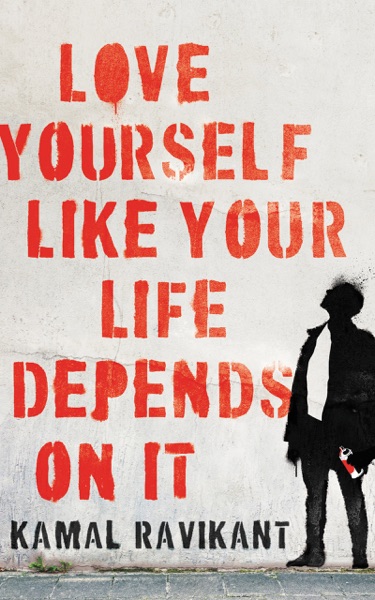
Talk to Love Yourself Like Your Life Depends On It like its author wrote you back.
Get the ideas that fit your life — not generic summaries.
- Chat with the book
- Audiobook-style main ideas
- Adapts to your life and goals
- Helps you take action
Love Yourself Like Your Life Depends On It, in detail
Kamal Ravikant wrote this book quickly after hitting what he describes as rock bottom — a period of serious illness, professional collapse, and psychological despair. His recovery, he says, came from a single daily practice: repeating the phrase "I love myself" until he believed it. The book is short, personal, and deliberately minimalist. It does not offer a comprehensive psychological framework. It offers one idea, applied insistently.
The core claim is that self-love is not a feeling you wait to receive but a practice you build through deliberate repetition. Ravikant draws loosely on neuroscience to suggest that thoughts create neural pathways, and that actively choosing a self-loving thought over a self-critical one can reshape how the mind responds over time. He is careful not to overclaim: he doesn't say this is proven therapy or that it replaces professional help. He says it worked for him, describes what he did, and leaves the reader to judge.
The practices are simple: a daily meditation using the phrase "I love myself," a review at the end of each day of what you are grateful for, and a commitment to noticing when the inner voice turns harsh and redirecting it. Ravikant also writes about the experience of telling the truth to himself about his life — not in a confessional way, but in the sense of refusing to pretend that things are fine when they aren't. The combination of honest reckoning and active self-compassion is the method.
The book is not for everyone. Its brevity can feel thin, and readers looking for empirical grounding or structured technique will find it wanting. The writing is sincere but unpolished in places. What it does well is make a simple case clearly: the relationship you have with yourself is the foundation of every other thing in your life, and if that relationship is contemptuous, everything built on it will be unstable. It is most useful as a starting point or a prompt — something to read in an hour and then sit with for a long time.
The big ideas
- 1.
Self-love is a practice, not a state you arrive at. Repeating 'I love myself' consistently and deliberately can shift the mind's default orientation over time.
- 2.
The quality of the relationship you have with yourself sets the floor on the quality of every other relationship and endeavor in your life.
- 3.
Honest self-assessment — seeing your situation clearly rather than performing optimism — is necessary before self-compassion becomes genuine rather than evasive.
