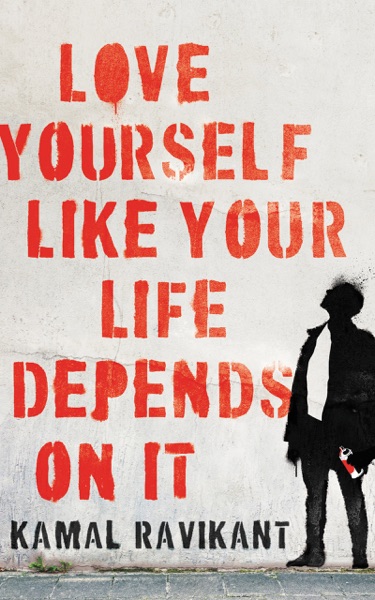
Love Yourself Like Your Life Depends On It by Kamal Ravikant is a 2012 self-help book about self-love, mental health, mindfulness. Self-love is a practice, not a state you arrive at. Repeating 'I love myself' consistently and deliberately can shift the mind's default orientation over time.
Summary
Kamal Ravikant wrote this book quickly after hitting what he describes as rock bottom — a period of serious illness, professional collapse, and psychological despair. His recovery, he says, came from a single daily practice: repeating the phrase "I love myself" until he believed it. The book is short, personal, and deliberately minimalist. It does not offer a comprehensive psychological framework. It offers one idea, applied insistently.
The core claim is that self-love is not a feeling you wait to receive but a practice you build through deliberate repetition. Ravikant draws loosely on neuroscience to suggest that thoughts create neural pathways, and that actively choosing a self-loving thought over a self-critical one can reshape how the mind responds over time. He is careful not to overclaim: he doesn't say this is proven therapy or that it replaces professional help. He says it worked for him, describes what he did, and leaves the reader to judge.
The practices are simple: a daily meditation using the phrase "I love myself," a review at the end of each day of what you are grateful for, and a commitment to noticing when the inner voice turns harsh and redirecting it. Ravikant also writes about the experience of telling the truth to himself about his life — not in a confessional way, but in the sense of refusing to pretend that things are fine when they aren't. The combination of honest reckoning and active self-compassion is the method.
The book is not for everyone. Its brevity can feel thin, and readers looking for empirical grounding or structured technique will find it wanting. The writing is sincere but unpolished in places. What it does well is make a simple case clearly: the relationship you have with yourself is the foundation of every other thing in your life, and if that relationship is contemptuous, everything built on it will be unstable. It is most useful as a starting point or a prompt — something to read in an hour and then sit with for a long time.
Talk to Love Yourself Like Your Life Depends On It like its author wrote you back.
Get the ideas that fit your life — not generic summaries.
- Chat with the book
- Audiobook-style main ideas
- Adapts to your life and goals
- Helps you take action
Key takeaways
- 1.
Self-love is a practice, not a state you arrive at. Repeating 'I love myself' consistently and deliberately can shift the mind's default orientation over time.
- 2.
The quality of the relationship you have with yourself sets the floor on the quality of every other relationship and endeavor in your life.
- 3.
Honest self-assessment — seeing your situation clearly rather than performing optimism — is necessary before self-compassion becomes genuine rather than evasive.
- 4.
Simple practices done consistently outperform complex practices done occasionally. The book's method is so simple it resists being abandoned for being too difficult.
- 5.
Harsh inner self-talk is not honest feedback; it is a habit, and like all habits it can be interrupted and replaced with deliberate effort.
- 6.
Gratitude and self-love reinforce each other: noticing what is good in your life makes the self easier to regard with warmth, and regarding the self with warmth makes it easier to notice what is good.
- 7.
Ravikant's recovery came not from a system but from a single committed practice. The lesson is about depth of application, not breadth of technique.
Discussion questions
Use these on your own, with a book club, or as chat starters in Superbook. Book club version, ready to copy or print →
- 1.
Ravikant says he was at rock bottom when he started this practice. Do you think his method would work for someone who is not in crisis, or does it require a certain desperation to take it seriously?
- 2.
The phrase 'I love myself' sounds simple to the point of being naive. What resistance comes up for you when you imagine repeating it sincerely?
- 3.
The book claims that the relationship with yourself is the foundation of everything else. Do you agree? What evidence from your own life supports or challenges that view?
- 4.
Ravikant doesn't cite clinical research for his claims. Does that bother you? What standard of evidence do you apply to practices related to mental and emotional wellbeing?
- 5.
The method is almost comically simple — one phrase, repeated. What does it say about how we approach self-improvement that such simplicity is unusual enough to become a book?
- 6.
When does inner criticism serve a useful purpose, and when does it become the self-destructive habit the book describes? Where is the line?
- 7.
Ravikant wrote this quickly and self-published it originally. The rawness is part of the point. How do you respond to personal self-help books written from lived experience rather than professional credential?
- 8.
The book is extremely short. Could the same ideas have been delivered as a long essay or a podcast episode? What does the book format add, if anything?
- 9.
Have you ever had a simple practice — physical, mental, or spiritual — that had effects that seemed disproportionate to its simplicity? What made it work?
- 10.
The book asks you to love yourself regardless of whether you think you've earned it. Is that an honest practice or a form of self-deception?
- 11.
What would it look like to apply the core idea — loving yourself as a committed practice — to the next difficult period in your own life?
Themes
Frequently asked questions
-
Is Love Yourself Like Your Life Depends On It worth reading?
Worth reading if you're open to a very simple, experience-based approach to self-compassion. Not worth it if you want clinical evidence, structured technique, or substantial depth. It's a one-sitting read that is most valuable as a prompt to think seriously about your internal relationship with yourself.
-
How long is this book?
Very short — around 80 pages in its original form, roughly one hour of reading. The expanded edition adds some additional material but remains brief by any standard.
-
What is the main practice in the book?
Repeating the phrase 'I love myself' as a daily meditation, combined with a gratitude review at the end of each day and a commitment to noticing and redirecting harsh inner self-talk. The author recommends doing this consistently for at least a month before judging whether it works.
-
Is this a religious or spiritual book?
It draws on mindfulness concepts and has a spiritual tone, but it is not religious in any doctrinal sense. Ravikant frames the practice in loose neuroscience terms and does not invoke any tradition or deity. Readers of any or no religious background should find it accessible.
-
Who should read this book?
Anyone who recognizes that their inner voice is predominantly critical and who wants a concrete, immediately applicable starting point for changing that. It's especially relevant for people in or recovering from difficult personal or professional periods.
Similar books
The Subtle Art of Not Giving a F*ck
Mark Manson

Man's Search for Meaning
Viktor E. Frankl
The Power of Now
Eckhart Tolle
Self-Compassion: The Proven Power of Being Kind to Yourself
Kristin Neff
