Talk to Made to Stick: Why Some Ideas Survive and Others Die like its author wrote you back.
Get the ideas that fit your life — not generic summaries.
- Chat with the book
- Audiobook-style main ideas
- Adapts to your life and goals
- Helps you take action
What it argues
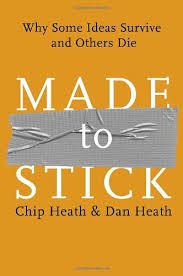
Made to Stick is Chip and Dan Heath's investigation into why some ideas take hold in people's minds and spread while others, equally true and well-reasoned, vanish the moment the conversation ends. Their answer is a six-part framework summarized as the acronym SUCCES: ideas that stick are Simple, Unexpected, Concrete, Credentialed, Emotional, and tell a Story. The Heaths contrast these principles with what they call the Curse of Knowledge — the tendency of experts to communicate at a level of abstraction that means nothing to the people they're trying to reach.
The book opens with the question of what makes an urban legend stick despite being false while important truths fail to stick despite being true. The Heaths use this gap to motivate the framework: stickiness isn't about accuracy, it's about structure. A simple, concrete, slightly counterintuitive message delivered through a story will travel farther than a comprehensive, nuanced one delivered as a bullet-point list.
What it gets right
- 1.
The Curse of Knowledge is the communicator's main enemy: once you know something deeply, you forget what it was like not to know it, and you communicate at the wrong level of abstraction.
- 2.
Simple means finding the core of the idea and expressing it without stripping it of meaning. The Commander's Intent in military planning is an example: one clear sentence that guides every decision.
- 3.
Unexpected ideas open a gap in the listener's knowledge and then close it. Curiosity is a response to an incomplete story, not a response to good content.
What it covers
Who wrote it
Chip Heath is a professor of organizational behavior at Stanford Graduate School of Business. Dan Heath is a senior fellow at Duke University's CASE center. Together they have co-authored four books, including Switch, Decisive, and The Power of Moments. Their work applies behavioral science and psychology research to practical questions of communication, change, and decision-making. Made to Stick, published in 2007, became a New York Times bestseller and is widely regarded as one of the most practical books ever written on communication and idea transmission.
