Made to Stick: Why Some Ideas Survive and Others Die by Chip Heath and Dan Heath is a 2007 psychology book about communication, persuasion, storytelling. The Curse of Knowledge is the communicator's main enemy: once you know something deeply, you forget what it was like not to know it, and you communicate at the wrong level of abstraction.
Summary
Made to Stick is Chip and Dan Heath's investigation into why some ideas take hold in people's minds and spread while others, equally true and well-reasoned, vanish the moment the conversation ends. Their answer is a six-part framework summarized as the acronym SUCCES: ideas that stick are Simple, Unexpected, Concrete, Credentialed, Emotional, and tell a Story. The Heaths contrast these principles with what they call the Curse of Knowledge — the tendency of experts to communicate at a level of abstraction that means nothing to the people they're trying to reach.
The book opens with the question of what makes an urban legend stick despite being false while important truths fail to stick despite being true. The Heaths use this gap to motivate the framework: stickiness isn't about accuracy, it's about structure. A simple, concrete, slightly counterintuitive message delivered through a story will travel farther than a comprehensive, nuanced one delivered as a bullet-point list.
Each chapter examines one element of SUCCES and is loaded with case studies: a nurse who used a concrete visual ("tapping veins" during a shift change) to prevent medication errors; an ad campaign where "it's the economy, stupid" beat sophisticated policy messaging because it was simple and unexpected; a teacher who used a classroom simulation of racial discrimination to teach students what it felt like rather than what it meant. The examples are drawn from advertising, education, public health, and business.
What the book does less well is explain why these principles work at the level of cognitive mechanism. The Heaths gesture toward psychology but don't engage deeply with the research on memory, attention, or persuasion. As a result, Made to Stick reads more like a practitioner's manual than a scientific account. That's not a fatal weakness — it remains one of the most useful books on communication ever written — but readers expecting a rigorous theory will find the framework more descriptive than explanatory. Seventeen years after publication, it holds up well.
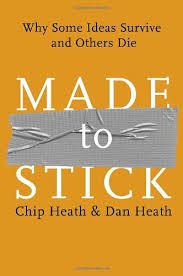
Talk to Made to Stick: Why Some Ideas Survive and Others Die like its author wrote you back.
Get the ideas that fit your life — not generic summaries.
- Chat with the book
- Audiobook-style main ideas
- Adapts to your life and goals
- Helps you take action
Key takeaways
- 1.
The Curse of Knowledge is the communicator's main enemy: once you know something deeply, you forget what it was like not to know it, and you communicate at the wrong level of abstraction.
- 2.
Simple means finding the core of the idea and expressing it without stripping it of meaning. The Commander's Intent in military planning is an example: one clear sentence that guides every decision.
- 3.
Unexpected ideas open a gap in the listener's knowledge and then close it. Curiosity is a response to an incomplete story, not a response to good content.
- 4.
Concrete images trump abstract statistics. A single individual's story generates more charitable giving than statistics about thousands of suffering people — a finding called the identifiable victim effect.
- 5.
Credibility comes from vivid specificity as much as from credentials. An unexpected detail signals that the speaker has been there and seen it.
- 6.
Emotional resonance comes from connecting to self-interest — not manipulation, but showing what's genuinely at stake for the listener.
- 7.
Stories act as mental flight simulators: they let people rehearse situations and decisions without experiencing them, which is why narrative is more durable than information.
- 8.
The six SUCCES principles work in combinations. The strongest ideas hit multiple elements at once — they're simple and concrete, unexpected and emotional, wrapped in a story.
Discussion questions
Use these on your own, with a book club, or as chat starters in Superbook. Book club version, ready to copy or print →
- 1.
Think of a message you need to communicate regularly at work or home. Where does the Curse of Knowledge most affect how you deliver it?
- 2.
The Heaths argue that simplicity doesn't mean dumbing down — it means finding the core. What's the core of an idea you're currently struggling to communicate clearly?
- 3.
The unexpected principle says you need to open a knowledge gap before you can close it. When was the last time you were genuinely curious about something because you didn't know how it ended?
- 4.
Concrete beats abstract in nearly every persuasion context. Can you translate an abstract goal or argument you currently use into a specific, sensory example?
- 5.
The identifiable victim effect — one person's story generating more response than statistics about thousands — is uncomfortable to apply deliberately. Is using it manipulation or just good communication?
- 6.
Stories act as mental flight simulators. What kind of story would allow the people you're trying to reach to rehearse a decision or change you're asking of them?
- 7.
Which of the six principles do you use most naturally? Which do you most consistently fail to apply?
- 8.
The book describes a teacher who dramatized racial discrimination to make it stick. Would that experiment be possible in the environment you work or teach in today? Why or why not?
- 9.
Urban legends stick because they hit multiple SUCCES principles at once despite being false. Does that suggest anything uncomfortable about the relationship between stickiness and truth?
- 10.
The military's Commander's Intent principle produces simple, durable guidance that survives contact with reality. What's the equivalent in your organization or project?
- 11.
The Heaths argue that most people with expertise communicate at the wrong level. Think of an expert communicator you admire. What do they do that compensates for the Curse of Knowledge?
- 12.
Made to Stick was published in 2007. Which principles feel more relevant now than they did then? Which feel more challenged by how people actually consume information today?
Themes
Frequently asked questions
-
What is Made to Stick about?
It explains why some ideas are remembered and spread while equally important ones are forgotten. The Heath brothers identify six principles — Simple, Unexpected, Concrete, Credentialed, Emotional, Story — that characterize sticky ideas, and argue that effective communicators apply these deliberately rather than by accident.
-
Is Made to Stick worth reading?
Yes, particularly for anyone who communicates professionally — writers, teachers, managers, marketers, public health workers, or anyone who needs to make an idea travel. The framework is practical, the examples are memorable, and the writing is clear. It is one of the most consistently useful books on communication of the last two decades.
-
Who should read Made to Stick?
Anyone who has ever had a good idea fail to land, or who has watched an inferior idea spread while a better one died. That's almost everyone who works in an environment where persuasion and communication matter. It is especially valuable for people who struggle to translate expertise into accessible, memorable communication.
-
What is the Curse of Knowledge in Made to Stick?
The tendency of people who know something deeply to forget what it was like not to know it. Experts communicate at the wrong level of abstraction because they can no longer remember the state of ignorance their audience is still in. The Heaths identify it as the central enemy of effective communication.
-
How long does it take to read Made to Stick?
About five to five-and-a-half hours at average pace. The chapters are organized around one principle each and can be read independently. Many readers finish it in two sittings, then return to specific chapters when working on a presentation or communication challenge.
Similar books
The Power of Moments: Why Certain Experiences Have Extraordinary Impact
Chip Heath and Dan Heath
Switch
Chip Heath and Dan Heath
Thinking, Fast and Slow
Daniel Kahneman
Influence: The Psychology of Persuasion
Robert B. Cialdini
