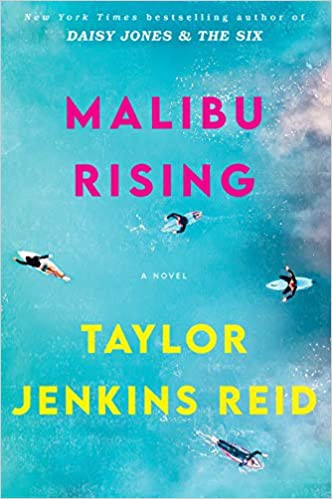
Talk to Malibu Rising like its author wrote you back.
Get the ideas that fit your life — not generic summaries.
- Chat with the book
- Audiobook-style main ideas
- Adapts to your life and goals
- Helps you take action
What it argues
Malibu Rising takes place across a single night in August 1983, when the four Riva siblings throw the most famous party in Malibu — and the night ends in fire. The novel unfolds in intercut timelines: the party itself, moving hour by hour through the night, and a multigenerational backstory that reaches back to the 1950s and the marriage of June, the siblings' mother, to Mick Riva, a rock-and-roll celebrity who left early and returned at intervals like a disaster. The present-night frame creates propulsive tension; the backstory does the real emotional work.
The four siblings — Nina, Jay, Hud, and Kit — are each carrying the weight of growing up without a father, raising each other in a Malibu beach house after their mother's breakdown, each shaped differently by the same childhood deprivation. Nina, the eldest, is a famous surfer who has also become the family's de facto parent; she is on the verge of collapse when the party starts. Reid is interested in what gets passed down: how a father's abandonment ripples through children who never quite got to be children, and how the same wound manifests differently depending on birth order, temperament, and luck.
What it gets right
- 1.
The children of a famous absent parent carry different wounds depending on when they were abandoned and who stepped into the gap — Reid traces those differences with precision.
- 2.
A single night of reckoning can do what years of avoidance couldn't: the party forces confrontations that daylight had kept deferred.
- 3.
Fame functions in the novel as a kind of chronic neglect — Mick Riva's stardom didn't cause his failures as a father, but it enabled them.
What it covers
Who wrote it
Taylor Jenkins Reid is an American novelist based in Los Angeles, best known for The Seven Husbands of Evelyn Hugo, Daisy Jones & The Six, and Malibu Rising. Her books are distinguished by their use of alternating timelines, ensemble casts drawn from the American entertainment industry, and an interest in how famous parents shape their children's lives. She has become one of the dominant forces in contemporary commercial fiction, with multiple titles adapted for television. Malibu Rising was a number-one New York Times bestseller.
