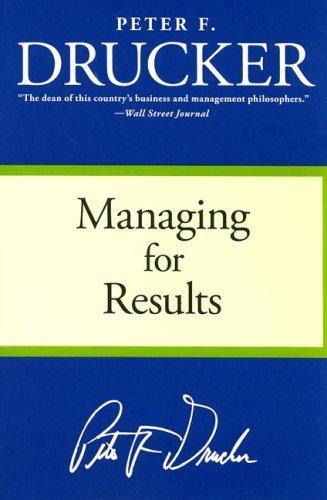
Talk to Managing for Results like its author wrote you back.
Get the ideas that fit your life — not generic summaries.
- Chat with the book
- Audiobook-style main ideas
- Adapts to your life and goals
- Helps you take action
What it argues
Managing for Results was Peter Drucker's first explicitly strategic book, published in 1964 and still in print. Where The Effective Executive is about personal effectiveness and The Practice of Management is about organizational structure, this book is about the economic logic of a business — how to understand what a company actually does, where its results actually come from, and what that implies for where attention and resources should go.
Drucker's starting premise is unsettling: in most businesses, the majority of activities, products, and customers do not contribute to results. They consume resources while the returns cluster in a small number of profitable areas. The first part of the book asks management to map this reality honestly. What are the genuine revenue producers? Where is the cost concentrated? Which customers generate real profit rather than mere revenue? Most managers, Drucker argues, cannot answer these questions clearly because they haven't looked.
What it gets right
- 1.
Results come from exploiting opportunity, not from solving problems. Time and resources spent on problems only restore the status quo.
- 2.
Revenue is not profit. Most businesses would find, if they looked carefully, that a small fraction of products and customers produces virtually all the real economic return.
- 3.
Strength, not effort, determines results. Resources should concentrate on the areas where the business already has a genuine advantage.
What it covers
Who wrote it
Peter F. Drucker (1909–2005) was an Austrian-American management writer and educator whose books shaped how generations of executives thought about their work. Born in Vienna, he emigrated to the United States in 1937 and spent decades teaching at Claremont Graduate University. His major works include The Concept of the Corporation, The Practice of Management, The Effective Executive, and Innovation and Entrepreneurship. Drucker introduced the concept of management by objectives, coined the term "knowledge worker," and was widely regarded as the father of modern management theory.
