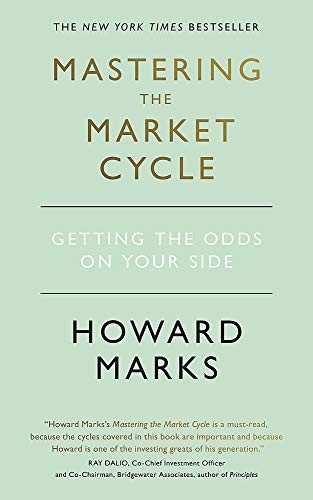
Talk to Mastering the Market Cycle like its author wrote you back.
Get the ideas that fit your life — not generic summaries.
- Chat with the book
- Audiobook-style main ideas
- Adapts to your life and goals
- Helps you take action
What it argues
Mastering the Market Cycle is Howard Marks's systematic argument that investment returns depend less on predicting the future than on understanding where you currently stand in the various cycles that govern markets. Marks is the co-founder of Oaktree Capital and has written investor memos for decades; this book is the distillation of his thinking on cycles as a framework for positioning rather than forecasting.
The book identifies multiple cycles that overlap and interact: the economic cycle, the credit cycle, the profit cycle, and — most importantly — the cycle of investor psychology. The psychological cycle is what amplifies the others. When sentiment is optimistic, investors accept lower risk premiums, lending standards loosen, and asset prices rise above fundamental value. When sentiment turns, the same dynamics work in reverse and often overshoot on the downside. Marks argues that the psychological cycle is simultaneously the most powerful and the most predictable in terms of its eventual direction, even if its timing can't be called in advance.
What it gets right
- 1.
Markets move in cycles, and the most important cycle is investor psychology. Greed and fear amplify every other cycle and are themselves cyclical.
- 2.
You can't predict when a cycle will turn, but you can often recognize the extreme. Knowing whether you're near a top or a bottom changes how you should position.
- 3.
Risk is not just volatility. It is the probability of permanent loss, which rises when investors accept low risk premiums due to overconfidence and falls when fear has pushed prices well below value.
What it covers
Who wrote it
Howard Marks is the co-founder and co-chairman of Oaktree Capital Management, one of the world's largest alternative investment firms with a focus on credit markets. He has written investor memos since 1990 that are widely read across the financial industry; Warren Buffett has cited them as among the first things he reads when they arrive. Marks is also the author of The Most Important Thing, a collection of his investment philosophy published in 2011. He is a graduate of the University of Pennsylvania's Wharton School.
