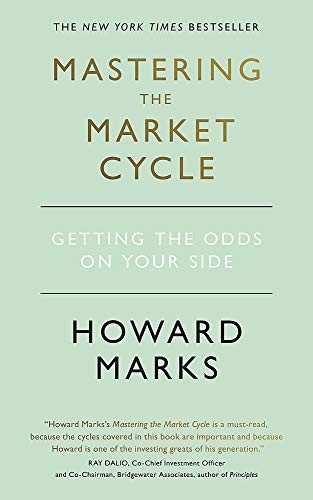
Mastering the Market Cycle by Howard Marks is a 2018 economics book about market cycles, risk management, investor psychology. Markets move in cycles, and the most important cycle is investor psychology. Greed and fear amplify every other cycle and are themselves cyclical.
Summary
Mastering the Market Cycle is Howard Marks's systematic argument that investment returns depend less on predicting the future than on understanding where you currently stand in the various cycles that govern markets. Marks is the co-founder of Oaktree Capital and has written investor memos for decades; this book is the distillation of his thinking on cycles as a framework for positioning rather than forecasting.
The book identifies multiple cycles that overlap and interact: the economic cycle, the credit cycle, the profit cycle, and — most importantly — the cycle of investor psychology. The psychological cycle is what amplifies the others. When sentiment is optimistic, investors accept lower risk premiums, lending standards loosen, and asset prices rise above fundamental value. When sentiment turns, the same dynamics work in reverse and often overshoot on the downside. Marks argues that the psychological cycle is simultaneously the most powerful and the most predictable in terms of its eventual direction, even if its timing can't be called in advance.
Much of the book is spent on the concept of knowing where you stand. Marks doesn't claim to predict tops and bottoms; he claims that at extremes, the odds are knowable. When greed dominates, risk is elevated even if prices keep rising. When fear dominates, the risk-return trade-off improves. The investor's job is to be more aggressive when the odds favor aggression and more defensive when they don't — a discipline Marks calls moving the dial.
The writing is deliberate and somewhat repetitive, which reflects Marks's belief that the ideas are counterintuitive enough to require reinforcement. Some readers find the repetition useful; others find the book could have been a long essay. The core insight — that psychology-driven cycles create predictable extremes without predictable timing — is genuinely valuable for anyone managing money through volatile periods.
Talk to Mastering the Market Cycle like its author wrote you back.
Get the ideas that fit your life — not generic summaries.
- Chat with the book
- Audiobook-style main ideas
- Adapts to your life and goals
- Helps you take action
Key takeaways
- 1.
Markets move in cycles, and the most important cycle is investor psychology. Greed and fear amplify every other cycle and are themselves cyclical.
- 2.
You can't predict when a cycle will turn, but you can often recognize the extreme. Knowing whether you're near a top or a bottom changes how you should position.
- 3.
Risk is not just volatility. It is the probability of permanent loss, which rises when investors accept low risk premiums due to overconfidence and falls when fear has pushed prices well below value.
- 4.
The credit cycle is among the most powerful and destructive. Easy lending inflates asset prices; tight lending deflates them, often faster than the inflation took.
- 5.
Moving the dial — allocating more aggressively or defensively depending on where you stand in cycles — is the most actionable application of cycle awareness.
- 6.
Investor psychology follows a recognizable arc: early recovery attracts few buyers, then momentum attracts the crowd, then complacency sets in, then euphoria, then denial, then panic.
- 7.
Contrarianism is not reflexive opposition. It is recognizing when consensus behavior has moved prices to extremes and positioning against those extremes.
- 8.
Superior investing is about having better assumptions about risk-adjusted returns, not about knowing the future. Cycles allow you to calibrate those assumptions even without certainty.
Discussion questions
Use these on your own, with a book club, or as chat starters in Superbook. Book club version, ready to copy or print →
- 1.
Marks says cycles can be recognized at extremes even if their timing can't be predicted. Do you think that distinction is meaningful in practice, or does it still require actionable calls?
- 2.
The credit cycle is described as one of the most dangerous. What were the signs of a credit extreme in the period leading up to 2008, and what would those same signs look like today?
- 3.
Marks argues that risk rises when investor sentiment is most optimistic. How do you reconcile that with the common experience of watching prices rise further after everyone you know is already excited?
- 4.
The psychological cycle moves from denial to panic. Have you ever personally experienced one of these emotional phases with a specific investment or asset class? What did you do?
- 5.
Moving the dial is about adjusting portfolio aggressiveness without claiming to predict exact tops and bottoms. What personal biases might make that discipline hard to actually execute?
- 6.
Marks is a credit-focused investor at Oaktree. How does his cycle framework apply differently to equity investors versus credit investors?
- 7.
Contrarianism requires being early or patient, often for years, before being right. What psychological and professional costs does that impose on investors, and how do you manage them?
- 8.
The book argues that most investors add risk at peaks and reduce it at troughs — precisely the opposite of what's optimal. What market structures or incentives produce this behavior?
- 9.
Marks references the cycle in real estate several times. How does the real estate market's relative illiquidity make it more or less susceptible to extreme cycle behavior than public equities?
- 10.
How does an individual investor, without Marks's decades of data and institutional context, apply cycle awareness in practice rather than as an intellectual exercise?
- 11.
The book is somewhat repetitive by design. Do you find that kind of reinforcement useful for counterintuitive ideas, or does it feel like padding?
- 12.
Marks emphasizes knowing where you are rather than predicting where you're going. What sources of evidence do you actually have access to that help calibrate current cycle position?
Themes
Frequently asked questions
-
Is Mastering the Market Cycle worth reading?
Yes, if you're interested in how professional investors think about risk and positioning across market cycles. It's more conceptual than tactical and works best alongside a more data-driven treatment of market history. Readers who enjoyed The Most Important Thing will find it compatible.
-
How long does it take to read?
Around four to five hours. The book is deliberate and somewhat repetitive — Marks revisits core ideas multiple times. Some readers race through it; others find themselves rereading sections to sit with specific arguments.
-
What's the central argument of Mastering the Market Cycle?
That investment outcomes are heavily influenced by where you currently stand in various overlapping cycles — economic, credit, and psychological — and that recognizing extremes, even without calling exact timing, allows an investor to tilt the odds meaningfully in their favor.
-
Who should read Mastering the Market Cycle?
Investors with some experience who want a framework for thinking about risk and positioning rather than a tactical trading system. It's better suited to long-term investors managing real capital than to beginners still learning basic asset allocation.
-
How does this book compare to The Most Important Thing?
The Most Important Thing is broader, covering multiple aspects of Marks's investment philosophy. Mastering the Market Cycle goes deeper on a single topic — cycles — with more systematic treatment. Both are worth reading, with The Most Important Thing being the better starting point.