Talk to Mathematics: Its Content, Methods and Meaning like its author wrote you back.
Get the ideas that fit your life — not generic summaries.
- Chat with the book
- Audiobook-style main ideas
- Adapts to your life and goals
- Helps you take action
What it argues
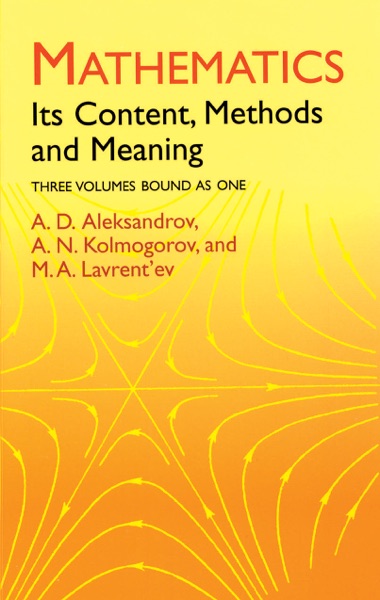
Mathematics: Its Content, Methods and Meaning is a three-volume survey of mathematics compiled by a group of eminent Soviet mathematicians, originally published in Russian in 1956 and translated into English by the American Mathematical Society in 1963. The work was edited by Aleksei Aleksandrov, Andrei Kolmogorov, and Mikhail Lavrent'ev — three of the leading Soviet mathematicians of the twentieth century — and was written for educated readers without advanced mathematical training, though it demands genuine intellectual effort throughout.
The ambition of the project is remarkable: to survey the entire landscape of mathematics as it existed in the mid-twentieth century, explaining not just the content of each field but its methods, its history, and its relationship to other branches of mathematics and to the sciences. The volumes cover analysis, algebra, geometry, topology, differential equations, probability theory, mathematical physics, number theory, and more. Each chapter was written by a specialist, which gives the treatment unusual depth, though it also means the writing quality and accessibility vary considerably.
What it gets right
- 1.
Mathematics is a unified intellectual enterprise, not a collection of disconnected techniques; understanding the connections between branches is as important as mastering any single one.
- 2.
Mathematical intuition and formal proof are complementary, not opposed: the intuition suggests what to prove, and the proof reveals whether the intuition was correct and what its scope actually is.
- 3.
The history of mathematics is inseparable from its content: why a problem was posed, what tools were available, and what analogies were productive are part of understanding why a result is true.
What it covers
Who wrote it
The three principal editors were Aleksei Aleksandrov (1912–1999), a geometer and rector of Leningrad State University known for work in differential geometry; Andrei Kolmogorov (1903–1987), one of the most important mathematicians of the twentieth century, who made foundational contributions to probability theory, turbulence, and information theory; and Mikhail Lavrent'ev (1900–1980), a mathematician and administrator who made major contributions to conformal mappings and helped establish the Siberian Branch of the Soviet Academy of Sciences. Together, they represented the breadth and depth of Soviet mathematics at its peak.
